How Is Gold Mined and Processed? The Complete 2026 Guide From Mine to Certified Gold Bar

Learn how is gold mined and processed, from exploration and extraction to refining and production. Discover the techniques used to transform raw ore into pure gold bars and jewelry.

Gold is the most written-about, most hoarded, and most universally coveted mineral in human history — and the journey from raw gold-bearing rock buried kilometres underground to the certified 24K gold bar that arrives in an investor’s vault is one of the most technically sophisticated industrial processes in the world.

Understanding how gold is mined and processed is not merely fascinating geology and chemistry — it is practically important for anyone buying physical gold bars, investing in gold mining stocks, evaluating sourcing claims from African gold dealers, or simply wanting to understand why gold costs what it does at the point of purchase.

This complete 2026 guide covers every stage of gold mining and processing in detail — from the geological exploration that identifies where gold exists, through the multiple extraction and concentration methods used across different deposit types, to the refining processes that purify crude gold to 99.99% (999.9) investment-grade certification. Along the way, we connect each stage to the African gold mining context that makes Uganda, Ghana, Tanzania, and South Africa the world’s most important physical gold sourcing geography for international buyers in 2026.

Key 2026 context: Global gold supply reached a record 5,002 tonnes in 2025, with mine production hitting an all-time high of 3,672 tonnes according to the World Gold Council.

Africa leads global production by region with 1,010 tonnes, driven by Ghana, Mali, and South Africa. Despite gold prices surging above USD 5,000 per ounce in early 2026, mine production grew just 1% in 2025 — illustrating the fundamental supply constraint that underpins gold’s structural price appreciation.

The mining cycle is lengthy, typically spanning 10–15 years from discovery to actual production, so gold output cannot quickly respond to price signals even when prices triple.


Stage 1: Geological Exploration — Finding Where Gold Hides

Before a single ounce of gold can be extracted from the earth, geologists must determine where viable gold deposits exist, how large they are, what grade (concentration) of gold they contain, and whether extraction at that location is technically and economically feasible. Exploration is the riskiest and most capital-intensive phase of the entire gold production cycle — and the one that ultimately determines everything that follows.

How Geologists Identify Gold-Bearing Terrain

Gold does not distribute itself randomly through the earth’s crust. It concentrates in specific geological environments created by ancient geological processes — volcanic activity, hydrothermal fluid circulation, erosion over millions of years, and tectonic forces that fracture rock and create the channels through which gold-bearing fluids migrate and deposit their mineral cargo.

Geological mapping is the foundation of exploration, with geologists studying regional and local rock formations, fault lines, and structural features to identify terrain types historically associated with gold mineralisation.

Gold is most commonly found in quartz veins — where hydrothermal fluids carrying dissolved gold cool and deposit it in rock fractures — in greenstone belt formations like Ghana’s Birimian belt or Uganda’s Kibali-Moto extension, and in association with minerals like pyrite (iron sulphide), which often acts as a chemical trap for gold.

Geophysical surveys — magnetic, gravitational, electromagnetic, and seismic — map subsurface density and conductivity variations without drilling, identifying anomalies that warrant closer investigation.

In Uganda’s Karamoja region, where the Uganda gold discovery in northern region has confirmed 31 million tonnes of ore, airborne magnetic surveys were the primary tool that first identified the subsurface structures hosting the gold mineralisation.

Satellite imagery and AI-assisted analysis represent the modern frontier of gold exploration. Advanced exploration techniques using satellite imagery, geophysical surveys, artificial intelligence, and machine learning algorithms help companies identify promising sites more efficiently.

Multispectral satellite imagery identifies surface mineralogy associated with gold systems; AI processes vast datasets from multiple survey types to rank exploration targets by probability of economic gold concentration.

Geochemical sampling involves collecting soil, rock, and stream sediment samples and analysing them for gold and pathfinder elements (arsenic, antimony, bismuth, tellurium) that consistently co-occur with gold deposits. A geochemical anomaly — an area where gold or pathfinder element concentrations significantly exceed regional background levels — triggers follow-up investigation.

Drilling is the definitive exploration tool. Exploratory drill holes extract core samples from depths of 50 to 600+ metres, and the gold grade (grams per tonne) of each core interval is determined by fire assay in an accredited laboratory.

The three-dimensional pattern of gold grades across a drill programme defines the size, shape, and average grade of the ore body. Mine feasibility requires sufficient gold at sufficient grade to support extraction at an economic cost — which in 2026, with gold above USD 4,000 per ounce, means much lower-grade deposits can be economically mined than would have been viable even five years ago.

Modern exploration in Africa benefits from both the continent’s geological richness and the progressive improvement of its infrastructure and regulatory frameworks.

How gold is mined and processed in Africa begins with exploration frameworks that span the artisanal sector’s empirical knowledge of river-gold locations to corporate geophysical programmes targeting billion-dollar ore bodies in Uganda, Guinea, and Tanzania.


Stage 2: Types of Gold Mining — Matching Method to Deposit

Once a viable gold deposit is confirmed, the appropriate mining method must be chosen. The right method depends on the deposit’s depth, the rock type hosting the gold, the geometry of the mineralisation, and the economic trade-off between extraction cost and gold recovery rate.

There are three primary gold mining methods used across the global industry, each with distinct applications in Africa’s gold-producing regions.

Placer Mining — The Oldest Method, Still Dominant in Africa’s Artisanal Sector

Placer gold occurs when primary gold deposits erode over millions of years and the gold — seven times denser than typical rock minerals — concentrates by gravity in riverbeds, flood plains, and alluvial sediments. Placer gold is free, unconsolidated, and requires no blasting or chemical liberation from host rock — making it accessible to artisanal miners with minimal equipment investment.

Panning is the simplest placer mining technique: water and sediment are swirled in a shallow pan, the lighter mineral particles wash over the rim, and the heavier gold settles in the bottom.

Panning is the method of choice for millions of artisanal miners across Uganda’s Busia and Mubende districts, in Ghana’s Tarkwa alluvial zones, and throughout Tanzania’s Lake Victoria goldfields. It is labour-intensive and captures only the coarser gold particles, leaving fine gold in the waste stream.

Sluicing improves on panning by channelling water-sediment mixtures through a box fitted with riffles — bars or baffles that create turbulence and trap heavy gold particles while lighter sediment washes through. Motorised sluice operations scale the approach to handle tonnes of sediment per hour, and this is the dominant method in Uganda’s Buhweju alluvial mining district, where seasonal river systems carry placer gold from primary lode sources in the Rift Valley escarpment.

Dredging is the most mechanised placer method, using floating equipment to scoop river or lake bed sediment in bulk and process it through onboard concentration equipment.

Modern dredges operate in Tanzania’s Geita district and in several Ugandan river systems, processing volumes of material that panning and sluicing cannot approach.

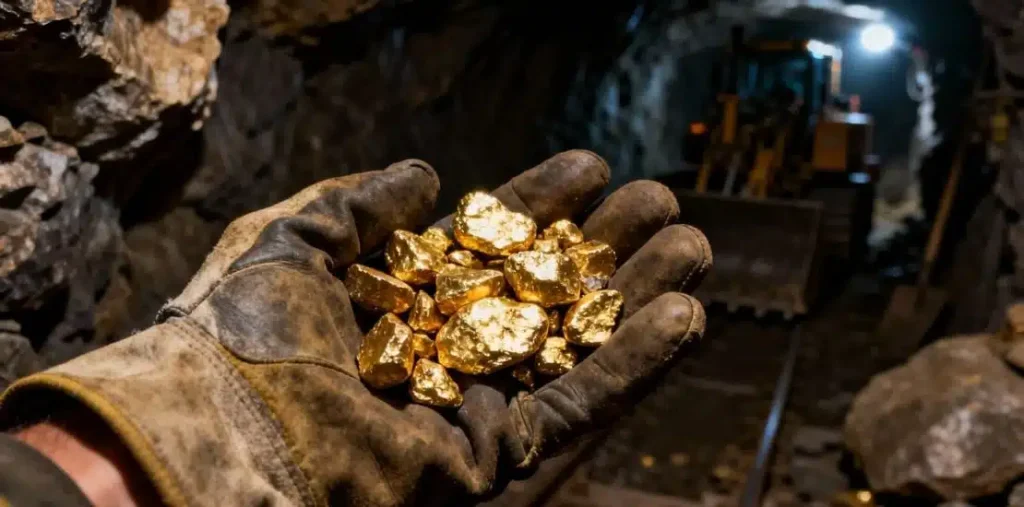
The placer gold from Africa’s artisanal sector — the gold dust and raw gold nuggets available through certified dealers — has typically been through panning or sluicing concentration and carries natural purity ranging from 85% to 98% depending on the deposit’s geological source and any initial concentration processing. Gold dust from Africa and raw gold nuggets sourced from Africa reflect this pre-refinery natural gold product — the starting material for the refinery chain that ultimately produces certified 24K investment bars.

Open-Pit Mining — The Dominant Industrial Method for Large, Near-Surface Deposits

Open-pit gold mining is used when a large, relatively low-grade ore body sits close enough to the surface that it can be accessed economically by removing the overlying rock. This is the method deployed at Ghana’s Tarkwa mine (Gold Fields), Uganda’s Wagagai operation in Busia (Wagagai Mining Uganda Ltd), and Tanzania’s Geita Gold Mine (AngloGold Ashanti) — three of Africa’s most productive gold mining operations.

The open-pit process begins with removing the overburden — the surface rock and soil above the ore body — using explosives, mechanical excavators, and large haul trucks.

As the pit deepens, roads are cut into the walls in a spiral pattern to allow trucks to access the ore at depth. Modern open-pit gold mines are enormous — some create craters several kilometres wide and hundreds of metres deep, removing and processing millions of tonnes of material per year.

The Wagagai Mine in Uganda’s Busia District processes approximately 5,000 tonnes of ore daily, producing approximately 1.2 tonnes of refined gold annually. This operation — Uganda’s first large-scale industrial gold mine, which became operational in 2025 after absorbing over USD 150 million in investment — is transforming the economics of Uganda’s gold sector.

The detailed overview of Uganda’s mine operations appears on the Uganda gold mines page, covering all producing districts from Busia and Mubende through to Karamoja.

Open-pit mining has the largest environmental footprint of any gold mining method — it removes vast quantities of earth, generates enormous tailings volumes, and requires significant water and energy inputs. Responsible operators manage these impacts through lined tailings storage facilities, water recycling systems, progressive reclamation, and increasingly, renewable energy integration.

Underground Mining — For Deep, High-Grade Deposits

When gold-bearing ore sits too deep for economic open-pit access, or when the deposit is high-grade but narrow (requiring precise extraction rather than bulk removal), underground mining is required.

In South Africa, underground gold mining has reached depths exceeding 3,000–4,000 metres in the Witwatersrand Basin — the deepest gold mines in the world — where rock temperatures exceed 50°C and extraordinary engineering is required to manage heat, ground pressure, and ventilation.

Underground mining uses a range of stoping methods (removing ore in structured blocks or panels), cut-and-fill techniques, and longwall mining — each suited to different ore body geometries and rock conditions. In Africa’s gold regions, underground mining is used at South Africa’s deep-level mines (AngloGold Ashanti, Harmony Gold), in Ghana’s Obuasi mine (AngloGold Ashanti), and increasingly in Uganda’s Mubende District where primary lode gold in quartz veins requires underground access for the higher-grade material.

Gold mining in South Africa explains the full scope of South Africa’s underground mining operations — the Witwatersrand’s geological structure, Rand Refinery’s role in processing the output to certified investment-grade gold, and why South African gold bars carry some of the most internationally recognised hallmarks in the global bullion market.


Stage 3: Ore Extraction — Getting Rock From Ground to Surface

Once the mining method is established, ore extraction begins. In open-pit operations, large-diameter holes are drilled in a pattern across the ore face, explosives are loaded, and controlled blasting fragments the rock into manageable pieces.

Excavators load the blasted ore onto 200–400-tonne haul trucks that carry it to the primary crusher. In underground operations, drill-and-blast cycles advance the mining faces in tunnels, and ore is hauled to the surface by conveyors, rail, or vertical shaft hoisting systems.

The gold grade in the extracted ore varies enormously between deposit types. High-grade underground mines in South Africa’s Witwatersrand historically averaged 10–20 grams of gold per tonne of ore. Modern open-pit heap leach operations like many in Ghana and Uganda process ore at 1–3 grams per tonne — yielding far less gold per tonne of material moved, but economically viable because of the scale of operations and reduced mining cost. Artisanal alluvial mining targets placer material at 0.1–2 grams per cubic metre of sediment — even lower grade, but accessible without capital-intensive processing.


Stage 4: Processing Raw Ore Into Concentrated Gold

Processing transforms crushed and ground ore — containing just fractions of a gram of gold per tonne of rock — into a gold-rich concentrate or solution that can be refined to investment-grade purity. This is where most of the chemistry happens and where the majority of a gold processing plant’s capital cost and energy consumption reside.

Crushing and Grinding — Liberating Gold From Host Rock

The first mechanical processing step is crushing large ore fragments to progressively smaller particle sizes, ultimately grinding them to a fine powder in ball mills or rod mills. This liberation step is critical because gold in hard-rock ore is locked inside mineral grains — it cannot be chemically or physically separated until the surrounding rock is ground fine enough to expose the gold particles.

Crushing and grinding are among the most energy-intensive operations in gold processing, consuming large amounts of electricity per tonne of ore processed. This energy demand is why the gold industry is increasingly investing in renewable energy — solar, wind, and hydropower — to reduce both operating costs and environmental impact.

Gravity Separation — Using Gold’s Extraordinary Density

Gold has a density of 19.32 grams per cubic centimetre — about 7 times denser than common rock minerals like quartz (2.65 g/cm³). This extraordinary density difference allows free gold particles to be separated from lighter minerals using gravity concentration equipment, without any chemical treatment.

Gravity concentration methods — jig concentrators, shaking tables, centrifugal concentrators, and spiral classifiers — are widely used in Africa’s artisanal sector for obvious reasons: they require no chemicals, are simple to operate, and efficiently recover coarser free gold from placer material.

They are also used as a primary recovery step in hard-rock processing plants where a significant portion of the gold occurs in a free, unlocked form that gravity can capture before chemical leaching.

The limitation of gravity separation is that it cannot recover gold that is chemically or physically locked inside sulphide minerals like pyrite or arsenopyrite — gold that requires chemical liberation methods to access.

Flotation — Concentrating Sulphide-Bound Gold

When gold occurs locked inside sulphide minerals — a very common situation in hard-rock deposits across West Africa — flotation is used to preferentially concentrate those gold-bearing sulphide particles from the gangue (waste) material.

Flotation works by conditioning ground ore slurry with specific collector chemicals that attach to the surfaces of the target sulphide particles, making them hydrophobic (water-repelling). Air bubbles are then introduced into the slurry; the hydrophobic particles attach to the bubbles and float to the surface, where they are skimmed off as a sulphide concentrate.

This concentrate — typically containing 20–100 grams of gold per tonne, compared to the 1–5 grams per tonne in the original ore — is then processed further through pressure oxidation or roasting to liberate the gold from the sulphide matrix before cyanide leaching.

Ghana’s Obuasi and Tarkwa mines both use flotation as a primary concentration step for their refractory sulphide ores — one reason why PMMC certification in Ghana represents comprehensive processing sophistication, not just simple panning. The list of gold refineries in Ghana covers the refinery infrastructure downstream from this processing chain.

Cyanide Leaching — The Primary Gold Extraction Chemistry

Cyanide leaching is the dominant gold extraction chemistry used in commercial gold mining worldwide, responsible for recovering approximately 90% of all gold mined globally.

The chemistry is conceptually simple: a dilute sodium cyanide solution dissolves gold from the ore, forming a soluble gold-cyanide complex that can be separated from the solid ore residue and processed to recover the gold in solid form.

Heap leaching is used for low-grade ores (typically below 1–2 grams per tonne) that cannot justify the capital cost of tank leaching. Crushed ore is stacked in large piles on lined pads, and dilute cyanide solution is sprinkled over the top. The solution percolates through the ore stack, dissolving gold and collecting as a gold-bearing “pregnant solution” at the base of the heap.

Heap leaching is slower than tank leaching but requires lower capital investment and is economically viable for very large, low-grade deposits. Many of Africa’s largest gold operations — including in Ghana’s Tarkwa district — use heap leaching for their lower-grade oxide ores.

Carbon-in-Leach (CIL) and Carbon-in-Pulp (CIP) tank leaching are used for higher-grade ores where the additional capital cost of closed-circuit tank leaching is justified by faster recovery and higher efficiency. Ground ore slurry is agitated in a series of tanks while cyanide solution dissolves the gold.

Activated carbon granules added to the tanks (in CIL) or in separate tanks (in CIP) adsorb the dissolved gold onto their surfaces, concentrating it for subsequent recovery.

The environmental risks of cyanide leaching — cyanide is acutely toxic to aquatic life and humans at elevated concentrations — require rigorous engineering controls including lined leach pads, secure solution containment, and continuous monitoring. Modern responsible gold mining operations use the International Cyanide Management Code (ICMC) as the industry standard for cyanide handling practices.

Due to cyanide’s toxicity and regulatory scrutiny, significant research effort is directed toward alternative leaching chemistries including thiosulfate (used commercially by Barrick at its Nevada operations), glycine (environmentally benign amino acid), and halide-based systems. These alternatives are gradually being adopted where economic and technical conditions support them, but cyanide remains the dominant commercial gold extraction chemistry in 2026.

Gold Recovery From Leach Solution — Electrowinning and Zinc Precipitation

After cyanide leaching dissolves the gold into solution, the gold must be recovered in solid form. The two primary methods are:

Electrowinning — an electric current is passed through the gold-bearing solution (called “eluate” after gold has been stripped from activated carbon), causing gold ions to deposit as metallic gold onto steel wool cathodes inside an electrowinning cell. The deposited gold sludge is periodically removed, dried, and smelted into rough dore bars for refining.

Zinc precipitation (Merrill-Crowe process) — fine zinc dust is added to the clarified pregnant leach solution, causing the gold to precipitate out of solution through a displacement reaction (zinc is more reactive than gold and displaces it). The gold precipitate is filtered, dried, and smelted to dore. This process is faster than electrowinning for high-flow solutions and is widely used in operations across Africa and South America.

Both methods produce dore bars — semi-refined gold alloy bars typically containing 70–95% gold with the balance silver, copper, and other impurities from the ore. Dore is the intermediate product that travels from mine sites to refineries for final purification to investment-grade standards.


Stage 5: Refining — From Dore to 999.9 Certified Investment-Grade Gold

Refining is the final and most technically precise stage of gold production, transforming dore bars into the certified 24K gold bars at 999.9 purity (99.99% gold) that meet LBMA investment-grade standards and that are used for gold bar investment, central bank reserves, and institutional trading.

The Miller Chlorination Process

The Miller process is the most widely used refinery method for producing high-purity gold from dore. Crude dore is melted in a furnace and chlorine gas is blown through the molten metal. Chlorine preferentially reacts with base metals (copper, lead, zinc), silver, and platinum-group metals to form chloride compounds that are less dense than gold and rise to the surface of the melt as slag and chloride gases.

The purified gold remaining in the furnace reaches approximately 99.5% (995 thousandths) purity after the Miller process — sufficient to meet LBMA’s minimum investment-grade standard for physical delivery.

The Miller process is used by Rand Refinery in South Africa — one of the world’s most respected LBMA-accredited facilities — and by multiple African refineries including the African Gold Refinery (AGR) in Entebbe, Uganda, and the nine licensed gold refineries now operating in Uganda more broadly. Gold mining in South Africa explains how Rand Refinery’s position in the South African gold value chain connects to the certified gold bars available for international purchase.

The Wohlwill Electrolytic Refining Process

For gold requiring the highest commercial purity — 99.99% (999.9 thousandths), the four-nines standard used for investment-grade LBMA gold bars — the Wohlwill electrolytic process is applied after the Miller process.

In Wohlwill refining, the 99.5% gold from the Miller process is dissolved in an electrolyte solution of gold chloride and hydrochloric acid. A current is passed through the solution, causing gold ions to deposit with exceptional purity onto a thin gold cathode. Impurities in the anode either remain in solution or form anode slimes.

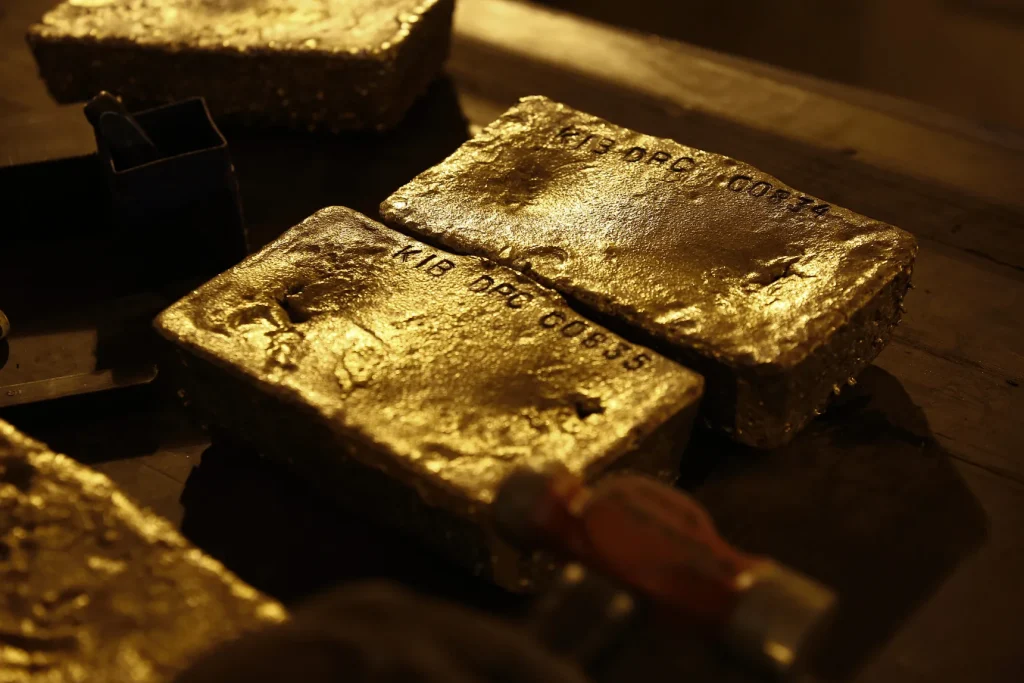
The resulting deposited gold achieves 99.99%+ purity and is melted, cast into bars, serial-numbered, and stamped with weight and purity before independent laboratory assay verification.

Every certified 24K gold bar produced by an accredited African refinery and sold through Buy Gold Bars Africa has passed through both the Miller chlorination and Wohlwill electrolytic processes — or their functional equivalents — to achieve the 999.9 purity stamp that appears on the bar face and is confirmed in the independent assay certificate that accompanies every purchase.

24K vs 22K Gold

What Happens After Refining: Certification, Assay, and Bar Production

After electrolytic refining produces 99.99% gold, it is melted and cast into standardised bar formats — typically 1-gram, 10-gram, 100-gram, 250-gram, 500-gram, and 1-kilogram investment bars for the retail and wholesale physical gold market; and 400-troy-ounce Good Delivery bars for the LBMA interbank market.

Each bar is stamped with: the refinery hallmark, the bar weight (in grams or troy ounces), the purity denomination (999.9 for 24K), and a unique serial number that creates permanent individual traceability.

An independent accredited laboratory — SGS, Bureau Veritas, PMMC, or the refinery’s own accredited assay facility — issues a certificate confirming the bar’s weight, purity, and serial number.

This assay certificate is the definitive proof of the bar’s gold content and is the primary document required for resale, insurance, and import declaration at destination customs.

The gold ingots for sale available through Buy Gold Bars Africa represent the finished product of this complete chain — ore extracted from African geological formations, processed through concentration and cyanide leaching, refined to 999.9 purity through Miller and Wohlwill processes, cast and stamped into investment bars, and independently certified before sale to international buyers.


Stage 6: Africa’s Gold Mining and Processing Landscape in 2026

Africa produces more gold by regional total than any other continental region — 1,010 tonnes in 2025 according to VT Markets data, driven by Ghana, Mali, South Africa, Tanzania, Uganda, and Guinea. This regional dominance reflects both the extraordinary geological richness of Africa’s Precambrian rock sequences and the progressive maturation of the continent’s mining and refining infrastructure.

Ghana — Africa’s Most Prolific Formal Producer

Ghana’s gold production reaches approximately 130–150 tonnes annually, the highest of any individual African country. The Birimian greenstone belt that runs through southwestern Ghana hosts world-class gold deposits at Tarkwa and Obuasi that have sustained large-scale mining for over a century.

Ghana’s PMMC (Precious Minerals Marketing Company) provides the certified assay and export documentation framework that makes Ghanaian gold internationally credible. The list of gold refineries in Ghana identifies the PMMC-accredited facilities that produce certified investment-grade bars from Ghanaian mine output.

South Africa — The World’s Most Historically Significant Gold Producer

The Witwatersrand Basin in South Africa’s Gauteng Province has produced more gold than any other geological formation on earth — an estimated 50,000 tonnes over 140 years of mining, representing approximately 40% of all gold ever mined in human history.

Today, South Africa produces approximately 95–110 tonnes annually from its increasingly deep-level operations, with Rand Refinery producing LBMA-accredited 999.9 purity bars and the iconic South African Krugerrand investment coin. Gold mining in South Africa covers this extraordinary geological and industrial history.

Uganda — East Africa’s Emerging Industrial Producer

Uganda’s gold sector has undergone a transformation — from a predominantly artisanal production environment to a developing industrial mining sector with nine licensed refineries, the operating Wagagai Mine in Busia, and confirmed reserves of 31 million tonnes of gold ore in Karamoja.

Gold exports reached a record USD 5.8 billion in the year to November 2025. The Uganda gold mines and Uganda gold discovery in northern region pages cover Uganda’s full mining geography, the Wagagai operation, and the reserve discovery implications.

Guinea — West Africa’s Gold Production Frontier

Guinea’s Siguiri Basin in the north contains substantial gold mineralisation on the same geological formation as Ghana and Mali, and the AngloGold Ashanti-operated Siguiri mine is one of West Africa’s most productive operations. Gold mining in Guinea covers Guinea’s mining landscape and its growing role in African gold supply.


Stage 7: Environmental and Social Dimensions of Gold Mining in Africa

Gold mining in Africa — like gold mining everywhere — has both significant economic benefits and real environmental and social costs that responsible sourcing practices must address.

Mercury Contamination in Africa’s Artisanal Sector

The most significant environmental issue in Africa’s artisanal gold mining sector is mercury amalgamation — a process in which liquid mercury is mixed with gold-bearing sediment to form a gold-mercury amalgam, which is then heated to vaporise the mercury and recover the gold.

An estimated 90% of Uganda’s artisanal miners and large proportions of artisanal miners across Ghana, Tanzania, and the DRC use mercury amalgamation, releasing several hundred tonnes of mercury into the environment annually across the continent.

Mercury bioaccumulates through aquatic food chains and is acutely toxic to humans — particularly pregnant women and children — causing neurological damage, kidney failure, and developmental disorders.

International programmes including Uganda’s planetGOLD initiative (supported by UNDP and the Global Environment Facility) are working to replace mercury amalgamation with safer gravity concentration and retort technologies, targeting cumulative mercury reductions of 15+ tonnes over five years in Uganda alone.

Buyers sourcing raw gold from Africa’s artisanal sector should verify that their supply chain partners actively support mercury-free mining transition — a key component of responsible sourcing for any operation claiming ethical supply chain credentials.

Community Displacement and Social Impact

Large-scale gold mining in Africa has periodically resulted in forced displacement of communities from gold-bearing areas — most prominently the 2017 eviction of approximately 50,000 artisanal miners from Uganda’s Mubende District to clear land for licensed industrial operations.

Community conflicts over land rights, royalty distribution, and employment access remain active social risks in multiple African gold-producing districts.

Responsible mining companies and certified gold dealers address these risks through community engagement programmes, transparent royalty payment frameworks, local employment preferencing, and support for artisanal mining formalisation that creates documented, legitimate livelihoods rather than displacing existing ones.

Gold Export Tax and Environmental Incentives in Uganda

Uganda’s 2024 introduction of a USD 200/kilogram export tax on unrefined gold — combined with the exemption from this tax for refined gold meeting 99.9% purity standards — creates a regulatory incentive structure that directly encourages environmental best practice.

By financially incentivising domestic refining rather than raw export, the tax structure promotes investment in processing infrastructure that both captures more value domestically and enables the traceability and assay certification that responsible sourcing requires. The gold export tax in Uganda covers this regulatory framework in detail.


From Mine to Your Investment: The Complete African Gold Value Chain

Understanding how gold is mined and processed in Africa gives you the context to evaluate every claim made by any dealer, refinery, or sourcing partner in the African gold market. The journey from raw ore to certified investment bar involves eight distinct stages:

  1. Geological exploration identifies the deposit through mapping, geophysics, and drilling
  2. Mine development constructs the infrastructure to safely access and extract the ore
  3. Ore extraction by open-pit blasting, underground drilling, or artisanal placer methods
  4. Crushing and grinding liberates gold from host rock by reducing particle size
  5. Concentration by gravity, flotation, or leaching increases gold content per tonne
  6. Leaching (typically cyanide-based) dissolves gold into solution for recovery
  7. Electrowinning or zinc precipitation recovers gold in solid form as dore
  8. Refining (Miller + Wohlwill processes) purifies dore to 999.9 certified investment gold

Every certified 24K gold bar from a legitimate African refinery has passed through this complete chain. When you purchase certified gold from Buy Gold Bars Africa, the assay certificate that accompanies your bar confirms the output of the final stage — independently verified 999.9 purity, unique serial number, and documented origin. Gold in Africa for sale and buy gold bars from Africa give you direct access to certified bars from this complete, documented production chain at source-country pricing below Western retail markets.


2026 Global Gold Production Statistics: Updated Reference Data

The following data reflects the most current available figures from the USGS Mineral Commodity Summaries 2026, World Gold Council, and VT Markets production analysis.

Global gold supply in 2025: 5,002 tonnes total, comprising 3,672 tonnes from mine production (a new all-time record) and 1,404 tonnes from gold recycling.

Mine production growth: Despite gold surpassing USD 5,000/oz in early 2026, mine production grew just 1% in 2025 — confirming the structural supply constraint that underpins gold’s long-term price appreciation.

Global mine production by leading country (2025 estimates):

CountryEstimated Production (tonnes)
China~380
Russia~330
Australia~284
Canada~220
United States~160
Ghana~135
South Africa~100
Indonesia~100
Mexico~100
Peru~98

Africa’s total production: 1,010 tonnes — the world’s largest gold-producing region by continent, driven by Ghana, Mali, South Africa, Sudan, Tanzania, and Uganda.

Global gold consumption by use (2025, USGS): Jewellery 40%, physical bars 24%, central banks and other institutions 21%, official coins and medals 7%, electrical and electronics 7%, other 1%. Physical bar investment demand grew 18% in the first nine months of 2025 compared to the same period in 2024 — reflecting the surge in private investor demand for physical gold at elevated price levels.


FAQs: How Is Gold Mined and Processed?

How is gold found in nature? Gold occurs in nature in two primary geological contexts: as primary lode gold deposits, where hydrothermal fluids deposited gold in quartz veins and rock fractures during ancient geological events; and as secondary placer deposits, where erosion has released lode gold and gravity has concentrated it in riverbeds and alluvial sediments. Both deposit types are commercially mined, with lode deposits (hard-rock mining) dominating global production and placer deposits (alluvial mining) dominating Africa’s artisanal sector.

What is the purity of newly mined gold before refining? Raw gold from different sources carries very different natural purity levels. Placer gold from African artisanal operations typically ranges from 85% to 98% natural purity — the remaining percentage being silver, copper, and mineral inclusions naturally co-occurring with the gold. Smelted dore bars from processing plants typically contain 70–95% gold.

Refining to investment-grade standards (99.5% minimum for LBMA certification, 99.99% for the 999.9 four-nines standard) is always required before gold qualifies as investment-grade bullion.

How long does gold mining and processing take from exploration to certified bar? The mining cycle is lengthy — typically spanning 10–15 years from discovery of a significant deposit to actual commercial production. Exploration and feasibility take 3–7 years; permitting and mine construction take 3–5 more years.

Once in production, ore-to-bar processing at a modern gold mine with an on-site refinery takes 3–10 days from ore extraction to refined bar. This long development cycle is the fundamental reason gold supply cannot quickly respond to price signals — explaining why gold’s price surge above USD 5,000/oz in early 2026 produced only a 1% increase in global mine production.

Is cyanide used in gold processing, and is it safe? Cyanide leaching is used in approximately 90% of commercial gold processing globally. Cyanide is highly toxic at elevated concentrations, but modern gold processing plants manage it under strict engineering controls, continuous monitoring, and regulatory oversight including the International Cyanide Management Code.

Spills and tailings dam failures have caused significant environmental damage in some instances, which is why responsible sourcing from certified operations matters. The International Cyanide Management Code certification is the industry benchmark for responsible cyanide management.

What happens to gold mining waste? Mining generates two primary waste streams: tailings (the residue after gold has been extracted from ore) and waste rock (barren material removed to access ore).

Tailings — typically containing low concentrations of cyanide, heavy metals, and processing chemicals — are stored in engineered tailings storage facilities with lined bases and drainage management systems to prevent contamination of groundwater and rivers.

Responsible operators progressively reclaim tailings storage areas and mine waste dumps with vegetation, working toward post-mining land restoration.

Where can I buy certified 24K gold bars from Africa? Buy Gold Bars Africa provides certified 24K gold bars at 999.9 purity sourced from licensed refineries in Uganda, Ghana, and South Africa, with independent SGS or PMMC assay certification, full export documentation, and insured international delivery.

The FAQs about buying gold from Africa cover the complete purchase process, documentation requirements, and responsible sourcing verification.


Conclusion: Gold Mining and Processing — The Science Behind Every Bar

Gold’s journey from geological deposit to certified investment bar is one of the most technically sophisticated industrial processes on earth, spanning exploration geology, blasting engineering, hydrometallurgical chemistry, electrochemical refining, and precision assay analytics. Understanding each stage gives gold buyers and investors the knowledge to evaluate sourcing claims, understand price differentials, and make informed decisions about the gold they own.

Africa’s 1,010 tonnes of annual gold production — extracted from geological formations that have concentrated gold over billions of years, processed through modern flotation and cyanide leaching plants, and refined to 999.9 purity in Uganda’s nine licensed refineries, Ghana’s PMMC-certified facilities, and South Africa’s Rand Refinery — represents the world’s most important source of certified physical gold for international buyers in 2026.

Accessing that supply at source-country prices through a licensed, verified partner is the practical outcome of understanding how gold is mined and processed.

Buy Gold Bars Africa provides that access — certified 24K bars from every stage of Africa’s gold production chain, with the documentation and logistics that make African gold straightforward to purchase, ship, and hold anywhere in the world.


Related Pages Worth Exploring

  • Buy gold bars from Africa — Certified 24K gold bars at 999.9 purity from African licensed refineries — the end product of the complete mining and processing chain described in this guide
  • Gold ingots for sale — Standardised investment-grade gold ingots from 50g upward, cast and certified through Africa’s gold refinery network
  • Gold in Africa for sale — Current certified gold bar availability from Uganda, Ghana, and South Africa at live LBMA-referenced pricing
  • Gold dust from Africa — Pre-refinery alluvial gold dust from Africa’s artisanal mining sector — the placer mining output before the refinery chain begins
  • Where can I buy raw gold from Africa? — Licensed sourcing options for raw gold nuggets and dore at the pre-refinery stage of Africa’s gold production chain
  • Uganda gold mines — Uganda’s gold mining geography, the Wagagai industrial mine, and the licensed artisanal sector across Busia, Mubende, and Karamoja
  • Uganda gold discovery in northern region — The Karamoja reserve discovery — 31 million tonnes of ore confirmed through the geological exploration methods described in this guide
  • Gold mining in South Africa — The Witwatersrand Basin’s extraordinary geology, South Africa’s deep-level underground mining operations, and Rand Refinery’s 999.9 gold bar production
  • Gold mining in Guinea — West Africa’s fastest-growing gold production region and the Siguiri Basin’s Birimian greenstone belt geology
  • List of gold refineries in Ghana — PMMC-accredited Ghanaian refinery facilities that produce certified investment-grade bars from Birimian belt mine output
  • Gold export tax in Uganda — Uganda’s USD 200/kg unrefined gold export tax and how it incentivises domestic refining over raw dore export
  • Gold stock investment guide — How gold mining and processing economics translate into gold mining stock valuations and investment returns
  • Dubai gold export rules — How African dore and certified bars are routed through Dubai’s DMCC gold trading infrastructure to Gulf and Asian markets
  • Buy gold in the UK — HMRC investment gold exemption, UK import rules, and how African certified bars qualify for VAT-exempt import
  • FAQs about buying gold from Africa — Common questions about gold sourcing, certification, assay standards, and responsible purchasing from Africa’s mining regions
  • FAQs about buying gold in Ghana — Ghana-specific mining and export documentation for international buyers
  • FAQs about buying gold in South Africa — Rand Refinery certification standards and South African export requirements
  • About Buy Gold Bars Africa — How Buy Gold Bars Africa connects to Africa’s gold mining and processing chain through licensed mine and refinery partnerships