
South Africa Gold Export Routes and Shipping Process
Gold is exported from South Africa through regulated precious-metals channels, with the required approvals, customs declarations and supporting documentation arranged before shipment. Exporters must comply with South Africa’s precious-metals legislation, applicable exchange-control rules and customs procedures.
Depending on the type and value of the gold, shipments may move through international air-cargo facilities or other approved logistics channels using specialised security arrangements. The process also involves meeting the importing country’s customs and gold-import requirements.
Overview of South Africa’s Gold Export Industry
South Africa has a long history as one of the world’s important gold-producing and refining countries. Although its gold-mining industry has changed considerably over the years, the country remains involved in gold production, refining, trading and international precious-metals markets.
The country’s gold industry includes mining companies, refiners, bullion dealers, manufacturers, authorised traders, financial institutions and specialist logistics providers. These businesses support different stages of the gold supply chain, from mineral production and processing to refining, trading and international distribution.
South Africa’s gold exports contribute to its mineral trade. According to the United States Geological Survey, South Africa exported approximately US$7.46 billion in gold in 2024. This demonstrates the continued importance of gold to the country’s mineral economy.
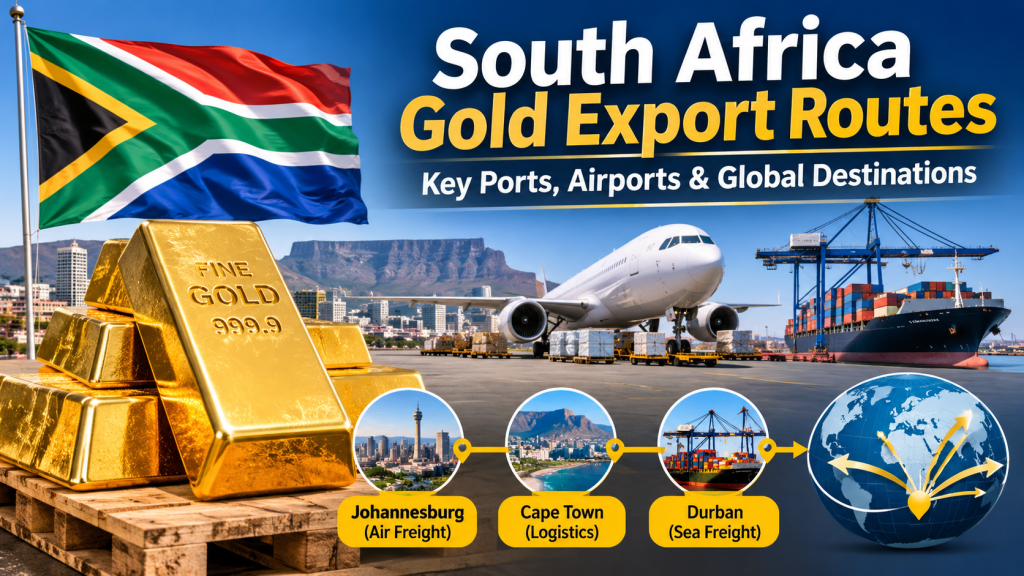
Johannesburg is an important commercial and financial centre for the precious-metals industry. It is also home to established refining and bullion-related businesses. Other cities, including Cape Town and Durban, provide commercial, freight and logistics services that may support international trade.
However, gold exports must follow the appropriate legal channels. The Precious Metals Act 2005 regulates dealings in precious metals, while customs and exchange-control requirements may also apply. Buyers and exporters should establish which approvals are necessary for the specific gold product before arranging transportation.
Major South Africa Gold Export Routes
South Africa has several international transport and logistics centres. The appropriate export route depends on the shipment’s origin, destination, value, form, security requirements and regulatory approvals.
Johannesburg (OR Tambo International Airport)
Johannesburg is a major centre for South Africa’s gold industry and international freight operations. OR Tambo International Airport provides extensive international air-cargo connections, making it a potential gateway for high-value shipments.
Air transportation is commonly suitable for investment-grade bullion because it can reduce transit time and the period during which valuable cargo is in transit. However, gold shipments require appropriate security arrangements, customs clearance and supporting documentation.
Exporters should confirm the carrier’s acceptance requirements, cargo handling arrangements and any applicable precious-metals approvals before dispatch.
Cape Town
Cape Town is another important commercial and logistics centre. Its international airport and port provide connections for different types of commercial cargo.
Depending on the shipment and the logistics provider, Cape Town may support the movement of precious metals and related commercial goods. The choice of route depends on the availability of specialised cargo handling, the destination and the exporter’s approved transportation arrangements.

Durban
Durban is one of South Africa’s major seaports and an important centre for international maritime trade.
Sea freight may be considered for certain commercial consignments where the shipment’s value, volume, security arrangements and delivery schedule make it appropriate. However, high-value investment gold is generally better suited to specialised secure transportation, and ordinary container shipping should not be assumed to be appropriate for bullion.
The export route must be selected according to the nature of the gold and the security and compliance requirements of the transaction.
Main Export Destinations for South African Gold
South African gold reaches international markets through established precious-metals trading networks. Importing countries and destinations vary according to global demand, refining capacity, investment activity, manufacturing requirements and international trade arrangements.
Some important international gold markets include:
United Arab Emirates (Dubai)
Dubai is an important international centre for gold trading, refining and bullion distribution. Its position as a regional trading hub makes it relevant to businesses dealing in precious metals across the Middle East, Asia and Africa.
Gold shipments destined for the UAE must comply with South African export requirements and the UAE’s applicable import, customs and precious-metals regulations.
Switzerland
Switzerland is a major international refining and bullion-trading centre. It has an established precious-metals industry serving investment markets, financial institutions and manufacturers.
Gold exported to Switzerland may enter refining, trading or investment supply chains, depending on its form and the buyer’s requirements.
United Kingdom
The United Kingdom is an established financial and precious-metals market. London plays an important role in international bullion trading, with market participants including banks, dealers, refiners and institutional investors.
Exporters must ensure that gold shipments meet the relevant UK import and customs requirements.
United States
The United States has a substantial market for investment gold, jewellery and industrial precious metals. Import requirements depend on the product’s classification, origin, value and intended use.
International sellers should establish the relevant customs procedures and any additional documentation required by the US authorities before shipping.
India
India is a major gold-consuming market, with demand from jewellery manufacturers, retailers and investors. Import procedures and applicable duties can affect the commercial viability of shipments.
Exporters should confirm that the intended importer is authorised to receive the gold and that the shipment meets India’s current import requirements.
Singapore and Hong Kong
Singapore and Hong Kong are important Asian precious-metals trading centres. Both have established financial and commercial networks that support international bullion transactions.
Buyers importing gold into these markets must comply with local customs, tax and precious-metals requirements.
Important: These countries are significant international gold markets, not a guaranteed list of South Africa’s largest gold export destinations. Actual trade destinations vary by year, product classification and reporting method.
How Gold Is Exported From South Africa
Exporting gold from South Africa involves several stages. The exact process depends on whether the gold is refined bullion, jewellery, semi-fabricated gold, unwrought gold or another precious-metal product.
Step 1: Gold Verification and Assay
Before export, the gold’s identity, weight and purity should be established. Buyers and exporters may use recognised assay facilities to determine the gold content and confirm the product’s specifications.
An assay report can provide information about:
- Gold purity or fineness
- Gross weight
- Fine-gold content
- Other metals present
- The product’s physical form
Independent verification can help buyers assess whether the gold meets the agreed specifications.
Step 2: Refining Where Applicable
Unrefined or partially processed gold may require additional processing before it meets a buyer’s specifications.
Refining removes impurities and produces gold of a specified fineness. The resulting product may be cast into bars or other forms depending on the refinery and the buyer’s requirements.
Not every shipment needs additional refining. Existing investment-grade bullion may already meet the required specifications.
Step 3: Obtain the Required Export Approvals
South Africa regulates the export of precious metals. Exporters must establish which approvals apply to their particular gold product and transaction.
Under the Precious Metals Act 2005, the export of unwrought or semi-fabricated gold is subject to the applicable approval requirements under exchange-control regulations. South African Reserve Bank guidance also directs applications for permission to export gold in any form to the South African Diamond and Precious Metals Regulator.
Exporters should therefore confirm the relevant procedure with the regulator and other competent authorities before arranging shipment.
Step 4: Prepare Export Documentation
The exporter prepares the commercial and regulatory documents required for the shipment.
These may include an invoice, packing list, assay certificate, applicable precious-metals approval, customs declaration and transport documents.
The information should be consistent across the documents, particularly the gold’s description, quantity, weight, value and destination.
Step 5: Customs Clearance
The shipment must be declared to the South African Revenue Service (SARS) in accordance with the applicable customs procedures.
Customs authorities may review the declaration and supporting documents, request additional information or inspect the shipment.
The exporter should ensure that all relevant approvals are in place before the gold is released for international transportation.
Step 6: Secure Transportation
Once the necessary approvals and customs procedures have been completed, the gold can be handed over to an appropriately equipped logistics provider.
High-value gold shipments require suitable security, controlled handling and documented custody transfers.
The logistics provider should confirm the route, transport arrangements, insurance terms where applicable and delivery requirements.
Step 7: International Delivery
After departure from South Africa, the shipment proceeds to its destination through the agreed transportation network.
The importer or its appointed customs representative completes the required import formalities. Depending on the destination, this may involve customs declarations, taxes, permits, inspections and verification of supporting documentation.
Final delivery may be arranged to the buyer’s business premises, refinery or approved vault, subject to the logistics provider’s services and local regulations.
Export Documentation Required for Gold From South Africa
Gold export documentation depends on the type of product, the transaction and the destination country. The following are examples of documents that may be required.
| Document | Purpose |
|---|---|
| Commercial invoice | States the seller, buyer, product description, quantity and transaction value |
| Packing list | Describes the shipment’s contents, packaging and weight |
| Assay certificate | Provides information about the gold’s purity and composition |
| Precious-metals export approval | Provides the applicable regulatory authorisation |
| SARS customs declaration | Records the export for customs purposes |
| Certificate of origin | Identifies the country of origin where required |
| Air waybill | Records the terms and details of an air-cargo shipment |
| Bill of lading | Records the terms and details of a sea-freight shipment |
| Insurance documentation | Sets out the applicable cargo insurance cover where arranged |
| Import permits or supporting documents | Satisfies destination-country requirements where applicable |
Not every shipment requires every document listed above. For example, an air waybill applies to air freight, while a bill of lading applies to sea freight.
The exporter should confirm the document checklist with the South African authorities, the freight provider and the importing country’s customs representative before dispatch.
Customs and Compliance Requirements
South African gold exports are subject to regulatory controls designed to ensure that precious metals are traded and transported through lawful channels.
South African Customs Procedures
SARS administers customs procedures for goods entering and leaving South Africa. Exporters must submit the appropriate customs information and ensure that the shipment is correctly described and valued.
Incorrect product descriptions, inaccurate weights and incomplete declarations can result in additional checks or delays.
Precious-Metals Export Controls
The Precious Metals Act 2005 establishes controls over the possession, acquisition, processing and export of precious metals.
The export requirements can differ depending on the form of the gold. In particular, unwrought and semi-fabricated gold is subject to specific approval provisions.
Exporters should consult the South African Diamond and Precious Metals Regulator (SADPMR) to establish the applicable requirements.
Exchange-Control Requirements
Exchange-control rules may apply to gold exports and the receipt of proceeds from international sales.
The South African Reserve Bank’s guidance addresses applications for permission to export gold and provides additional requirements for particular categories of gold exports.
Exporters should confirm the applicable exchange-control position with their authorised dealer or relevant authority.
Tax Obligations
Tax treatment depends on the nature of the transaction, the product and the parties involved. Exporters should consider applicable VAT, income-tax and customs requirements rather than assuming that every gold export is automatically tax-free.
Professional tax advice may be necessary for complex or high-value transactions.
Anti-Money Laundering and Know Your Customer Checks
Gold is a high-value commodity and may be exposed to risks involving fraud, money laundering and illicit trade.
Buyers and sellers should conduct appropriate due diligence, verify business identities and maintain records of the transaction. Depending on the parties and services involved, additional AML and KYC requirements may apply.
Secure Gold Transportation From South Africa
Gold is a high-value commodity, so transportation requires more than ordinary freight arrangements. Exporters should use logistics providers with appropriate experience, security procedures and precious-metals handling capabilities.
Important security measures include:
Insured Transportation
Where available, appropriate cargo insurance can protect against specified risks during transportation. Buyers should check the policy wording, insured value, exclusions, coverage limits and the parties responsible for arranging the insurance.
Do not assume that standard courier or freight insurance automatically covers investment-grade gold.
Tamper-Evident Packaging
Secure packaging helps protect the shipment and makes unauthorised access easier to identify.
Packaging arrangements may include sealed containers, security labels and documented package identification.
Shipment Tracking
Tracking systems help exporters and buyers monitor shipment progress and identify significant changes in the delivery schedule.
For high-value shipments, tracking should be supported by controlled access to shipment information and secure communication between the parties.
Chain of Custody
A documented chain of custody records who handles the gold at each stage of the transportation process.
This may include the exporter, secure collection team, airport cargo handler, carrier, customs representative and final recipient.
Clear custody records help reduce uncertainty and support accountability.
International Shipping Options for South African Gold
The best shipping method depends on the gold’s value, quantity, form, destination and security requirements.
Air Freight
Air freight is commonly suitable for high-value gold shipments because it offers relatively fast international transportation.
Specialist cargo arrangements may be required, and the exporter must confirm that the airline and handling provider accept the particular type of precious-metal shipment.
Sea Freight
Sea freight may be considered for selected commercial shipments where the quantity, security arrangements and delivery schedule make it appropriate.
It generally involves longer transit times and requires careful planning of cargo security, insurance and port handling.
Courier Services
Standard courier services should not automatically be assumed to accept bullion or other precious metals.
Some providers may handle related documentation or eligible smaller products, but acceptance policies, insurance limits and restrictions must be checked before booking.
Specialist Precious-Metals Logistics
Specialist logistics companies provide secure transportation and handling solutions for high-value commodities.
Depending on the provider and route, services may include secure collection, controlled storage, international transportation, customs coordination and delivery to approved facilities.
Exporters should obtain written confirmation of the provider’s services and coverage before dispatch.
How International Buyers Receive Gold From South Africa
The gold export process does not end when the shipment leaves South Africa. The importer must also satisfy the requirements of the destination country.
Destination-Country Customs Clearance
The importer or appointed customs broker submits the required import declaration and supporting documents.
Authorities may verify the product description, declared value, origin, quantity and applicable permits.
Import Duties and Taxes
Import duties, VAT or other taxes may apply depending on the country, product classification and transaction. Buyers should establish the expected charges before purchasing so that they can calculate the total landed cost.
Gold Verification
The receiving buyer may arrange an inspection or independent assay to confirm that the delivered gold matches the agreed specifications. The inspection process should be agreed upon before shipment, including how discrepancies will be handled.
Final Delivery or Vault Storage
After customs clearance, the gold can be delivered to the buyer or another approved receiving facility, depending on the logistics arrangement.
Some specialist providers offer secure vault delivery or storage services. Availability, fees and conditions vary by provider and destination.
Factors That Affect Gold Export Time From South Africa
There is no single guaranteed export timeframe for every gold shipment. The time required depends on regulatory approvals, customs processing, logistics availability and destination-country procedures.
Key factors include:
- Documentation accuracy: Missing or inconsistent information can delay regulatory checks and customs clearance.
- Export approvals: The time required to obtain the applicable precious-metals and exchange-control approvals can affect the dispatch date.
- Customs inspections: Authorities may request additional documents or inspect a shipment before release.
- Flight availability: Air-cargo capacity and routing affect the transportation schedule.
- Destination-country procedures: Import permits, customs checks and payment of applicable charges can affect final delivery.
- Security arrangements: Specialised collection, handling and approved receiving arrangements may require additional coordination.
Buyers should request a shipment schedule that separates approval time, customs processing, international transit and destination clearance.
Common Challenges When Exporting Gold From South Africa
Even when a transaction is legitimate, exporters may encounter practical and regulatory challenges.
Missing or Incomplete Documentation: An export declaration that does not match the invoice, assay report or packing list may attract additional scrutiny.
How to avoid it: Check all documents before submitting the export application or booking transportation.
Delays in Export Approvals: Precious-metals exports are regulated, and the relevant approval process can take time.
How to avoid it: Identify the applicable approvals early and do not arrange dispatch before the necessary authorisations are confirmed.
Customs Delays: Customs authorities may request clarification, supporting evidence or physical inspection.
How to avoid it: Use accurate declarations and work with an experienced customs representative.
Shipment Security Risks: Gold can attract theft and fraud, particularly when transportation arrangements are poorly controlled.
How to avoid it: Use appropriate secure logistics, verify service providers and maintain documented custody records.
Regulatory Changes: Export and import requirements can change, affecting permits, declarations, taxes and documentation.
How to avoid it: Confirm current requirements with the relevant authorities before each transaction.
Incorrect Gold Declarations: Misrepresenting the purity, value, quantity or physical form of gold can create serious compliance problems.
How to avoid it: Ensure that the commercial invoice, assay report, customs declaration and other supporting documents accurately describe the shipment.
How to Verify a South African Gold Exporter
Before purchasing gold from a South African supplier, international buyers should conduct due diligence. A professional-looking website or an attractive quotation is not proof that a business is authorised to sell or export gold.
Consider the following checks:
Verify Company Registration: Check the company’s registration details and confirm that its legal name matches the business documents and transaction agreements.
Confirm Precious-Metals Authorisation: Ask the exporter to explain the legal basis on which it possesses, deals in or exports the gold.
Where a licence, permit or approval is required, request the relevant documentation and verify it with the issuing authority.
Request Independent Assay Documentation: Ask for an assay report that identifies the tested material, its weight and purity. Where necessary, confirm the report directly with the issuing laboratory.
Review the Gold’s Origin and Supporting Documents: Request appropriate evidence of origin and lawful acquisition. The documentation should be consistent with the product being sold and the applicable regulatory requirements.
Assess the Export and Shipping Arrangements: Ask who will handle customs clearance, which logistics provider will transport the shipment, what insurance is available and who is responsible for destination-country import procedures.
Check Business Reputation: Review the supplier’s business history, references, transaction procedures and responsiveness to verification requests.
Avoid Unusual Payment Requests: Be cautious of pressure to make immediate payments, unexplained fees, payments to unrelated third-party accounts or promises of guaranteed profits.
A legitimate transaction should have clear terms, verifiable counterparties and supporting documentation.
FAQs About Gold Exports From South Africa
How Is Gold Exported From South Africa?
Gold is exported from South Africa through regulated precious-metals and customs procedures. The exporter establishes the applicable approvals, verifies the gold, prepares the required documentation and completes customs clearance before arranging secure international transportation. The importer must then meet the destination country’s customs and import requirements.
Which Airport Handles Most Gold Exports From South Africa?
OR Tambo International Airport in Johannesburg is a major international air-cargo gateway and an important logistics centre for high-value shipments. However, a definitive claim that it handles most South African gold exports would require specific official shipment data. The appropriate airport depends on the exporter, shipment origin, carrier and destination.
Where Does South Africa Export Most of Its Gold?
South African gold is traded through international markets, including major destinations in Asia, Europe and other regions. Trade data can identify recorded destination countries, but results may differ depending on the reporting year, product classification and whether shipments are recorded under specific or unspecified destinations.
What Documents Are Required to Export Gold From South Africa?
Depending on the gold product and transaction, documents may include a commercial invoice, packing list, assay certificate, applicable precious-metals export approval, SARS customs declaration, certificate of origin and air waybill or bill of lading. Destination-country import documents may also be required.
Can Foreigners Buy and Export Gold From South Africa?
Foreign buyers may be able to purchase gold from South African suppliers, but buying gold does not automatically grant the right to export it. The exporter must comply with applicable precious-metals, exchange-control and customs requirements. Foreign buyers should verify the seller’s authority and establish the export and import procedures before paying.
How Long Does a Gold Export From South Africa Take?
The timeframe varies according to the gold’s form, required approvals, customs checks, flight availability and destination-country procedures. The total process includes preparation and approval time, customs clearance, international transit and import clearance. Buyers should obtain a transaction-specific schedule rather than rely on a universal delivery estimate.
What Logistics Companies Transport Gold Internationally?
Gold may be transported by specialist precious-metals logistics providers and other carriers that expressly accept the relevant shipment. The exporter should verify the provider’s precious-metals handling capability, route availability, security arrangements, insurance terms and destination delivery services before booking.
Conclusion: Exporting Gold From South Africa Through Legal and Secure Channels
Exporting gold from South Africa requires careful coordination between the exporter, precious-metals regulator, customs authorities, logistics providers and the international buyer. The process involves verifying the gold, obtaining the necessary approvals, preparing accurate documentation, completing customs procedures and arranging secure transportation.
For international buyers, choosing a supplier with verifiable business credentials, clear transaction terms and appropriate export arrangements is essential. Before committing to a purchase, confirm the gold’s specifications, supporting documents, applicable approvals and the total cost of delivery to your destination.
Buy Gold Bars Africa Ltd provides information and assistance to buyers exploring gold sourcing opportunities in Africa. If you are considering purchasing gold, contact our team to discuss your requirements and the documentation and procedures relevant to your proposed transaction.
Contact Buy Gold Bars Africa Ltd to Discuss Buying Gold in Africa

