24K Gold Price in Russia: A Comprehensive Guide (2026)
Covers 24K, 22K, and 18K gold pricing in Russia, by gram, 10 gram, 8 gram, and tola, in both Ruble and USD, plus a comparison against India’s gold market.
The price of 24-karat (24K) gold in Russia remains a focal point for investors, economists, and everyday citizens, reflecting both global market trends and the country’s distinct economic landscape.
Gold, universally regarded as a safe-haven asset, holds particular significance in Russia — a country with a long gold-mining history, substantial reserves, and a currency, the Russian Ruble (RUB), that has seen considerable volatility in recent years.
Russian Gold Price Today
As of today, the global spot price of gold sits at approximately $4,120 per troy ounce. Converted at the current USD/RUB exchange rate of roughly 85.5, that puts the 24K gold price in Russia at approximately:
| Metric | Price (RUB) |
|---|---|
| Price per Ounce | ~352,260 |
| Price per Gram | ~11,323 |
This figure reflects a direct conversion from the global gold price, which is typically quoted in US dollars, adjusted for the Ruble’s current exchange rate. The Ruble has weakened notably over the past year — trading in the 70–77 range against the dollar in early-to-mid 2026 before depreciating further to the mid-80s range by late August — meaning Ruble-denominated gold prices have risen even faster than the underlying dollar price of gold itself.
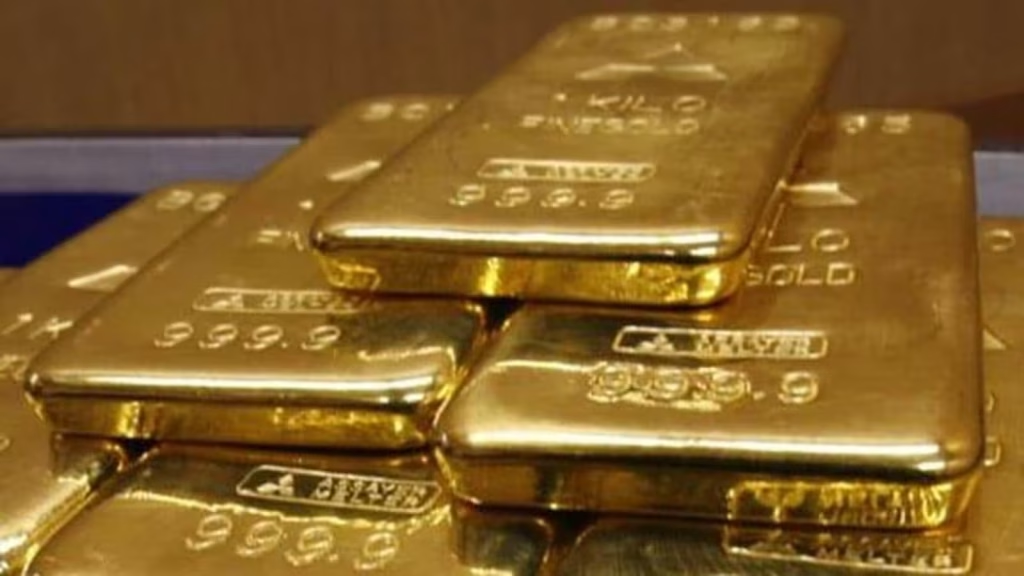
For context, 24K gold represents pure gold — 99.9% or higher in purity, unalloyed with other metals — making it the global benchmark for investment pricing. In Russia, this purity level is most commonly traded as bullion bars and coins, with prices fluctuating daily based on global supply and demand alongside domestic macroeconomic conditions.
Historical Context of Gold in Russia
Russia’s relationship with gold dates back centuries, with significant discoveries in the Ural Mountains in the 1740s marking the beginning of the country’s mining legacy. Today, Russia remains one of the world’s top gold producers, extracting several hundred tonnes annually and holding substantial official reserves.
Historically, gold prices in Russia have been shaped by both international trends and domestic policy. During the Soviet era, gold functioned as a state-controlled asset, often used to bolster foreign reserves.
The transition to a market economy in the 1990s introduced far greater price volatility, with domestic prices reflecting both Ruble fluctuations and global commodity cycles.
The 21st century has seen gold’s role in Russia evolve further, particularly following Western sanctions imposed after the 2014 Crimea annexation and the 2022 invasion of Ukraine, which prompted the Russian central bank to expand its gold reserves as part of a broader reserve-diversification strategy away from dollar-denominated assets.
Factors Influencing 24K Gold Prices in Russia
Several interconnected factors drive the price of 24K gold within Russia, blending global market forces with local dynamics:
Global gold market trends — gold prices are set on international exchanges in London and New York, with the spot price reflecting real-time global supply and demand. Sustained gold strength through 2025 and into 2026, driven by inflation concerns and continued central bank buying, has pushed the underlying dollar price well above levels seen just a few years ago, and that trend feeds directly into Russia’s domestic pricing.
Ruble exchange rate volatility — the Ruble’s value against the dollar significantly affects local gold prices. A weaker Ruble raises the local-currency cost of gold even when the underlying dollar price hasn’t moved, meaning currency movement alone can drive substantial swings in the Ruble-denominated gold price.
Domestic demand and investment — gold serves as a store of value for many Russian citizens and institutions during periods of currency uncertainty, with demand for 24K products typically rising during Ruble volatility or broader economic stress. The Bank of Russia has also been a significant institutional buyer in recent years, adding to reserves as part of its broader diversification strategy.
Production and domestic supply — Russia’s substantial gold mining industry, led by major domestic producers, ensures a steady base supply, though domestic prioritization and export dynamics can influence how much gold remains available within local markets versus international ones.
Recent Trends and Market Milestones
Gold pricing in Russia has moved through genuinely significant swings in recent years, shaped as much by currency movement as by the underlying global gold price. A notable historical episode occurred in 2022, when the Central Bank of Russia temporarily fixed the domestic gold-purchase price at a flat rate for several months, an unusual intervention aimed at stabilizing the currency amid the onset of sanctions. While short-lived, that episode underscored gold’s strategic importance within Russian monetary policy during periods of acute currency stress.
More broadly, the gap between global dollar-denominated gold price gains and Ruble-denominated gains in Russia has often been wider than in most other markets, precisely because Ruble volatility compounds on top of the underlying global gold trend rather than offsetting it.
Economic and Cultural Implications
The price of 24K gold in Russia carries real economic and cultural weight. Economically, gold’s appreciation offers a hedge against both inflation and currency risk for investors, with minted coins and internationally recognized bullion products remaining popular among Russian buyers. For everyday citizens, however, sustained high prices make gold jewelry — often produced at 24K or 22K purity in Russia — meaningfully less affordable, which has gradually shifted retail demand toward lower-karat alternatives in the jewelry market specifically.
Culturally, gold retains deep significance in Russia, from its role in Orthodox iconography to long-standing traditions in jewelry and gift-giving. Rising prices place real strain on that cultural continuity for ordinary buyers, even as gold’s broader symbolic association with stability and enduring value grows more pronounced during economically turbulent periods.
22K and 18K Gold Price in Russia
While 24K gold remains the benchmark for investment bullion, lower-karat gold is far more common in jewelry, both in Russia and globally. Here’s how today’s prices break down by purity:
| Purity | Price per Gram (RUB) | Price per Gram (USD) |
|---|---|---|
| 24K (99.9%) | ~11,324 | ~$132.44 |
| 22K (91.6%) | ~10,381 | ~$121.42 |
| 18K (75.0%) | ~8,493 | ~$99.33 |
The 22K gold price in Russia tracks 24K closely, since 22K retains over 91% pure gold content, making it a common choice for higher-end jewelry that still carries strong intrinsic value. The 18K gold price in Russia sits meaningfully lower, reflecting its 75% gold content — a popular choice for everyday jewelry where durability and affordability matter more than maximizing gold content.
Gold Price in Russia by Weight: 1 Gram, 8 Gram, 10 Gram, and 1 Tola
Gold is bought and sold in a range of standard weights, and the unit that matters most often depends on local convention. Here’s how 24K gold pricing in Russia breaks down across the most commonly searched weights:
| Weight | Price (RUB) | Price (USD) |
|---|---|---|
| 1 gram | ~11,324 | ~$132 |
| 8 grams | ~90,589 | ~$1,060 |
| 10 grams | ~113,236 | ~$1,324 |
| 1 tola (11.664g) | ~132,090 | ~$1,545 |
| 1 troy ounce (31.1g) | ~352,260 | ~$4,120 |
The 10 gram gold price in Russia is a particularly common reference point for bullion buyers, since 10-gram bars represent one of the most widely traded investment sizes globally. The 8 gram gold price in Russia is less standard within Russia itself but is frequently searched by buyers comparing pricing conventions across different countries and markets. The tola — a traditional South Asian unit equal to 11.664 grams — isn’t a standard Russian measure, but the conversion is useful for anyone comparing Russian gold pricing against South Asian or Middle Eastern markets, where the tola remains a common trading unit.
Gold Price in Russia in USD vs. Ruble
Because gold is a globally traded commodity priced in US dollars, understanding the gold price in Russia in USD alongside the Ruble figure gives a clearer sense of how much of any price movement is driven by gold itself versus currency fluctuation.
At today’s rate of roughly 85.5 RUB per USD, the two figures track closely — but that relationship shifts constantly. A stable USD gold price can still mean a rising or falling Ruble price depending entirely on which direction the currency itself is moving, which is exactly why Russian gold buyers watch the exchange rate as closely as the metal’s underlying dollar value.
Gold Price in Russia vs. India
Comparing the gold price in Russia vs. India highlights just how differently domestic gold markets can behave even when tracking the same global benchmark. As of today, 24K gold in India trades at approximately ₹15,982 per gram (roughly $167 at current exchange rates) according to major Indian gold-rate trackers — noticeably above the raw international spot price of about $132.44 per gram.
That gap largely comes down to India’s import duty structure: gold entering India carries customs duty alongside a 3% GST, plus additional local dealer premiums, all layered on top of the international price before it reaches a retail buyer. Russia’s domestic pricing, by contrast, tends to track closer to a straightforward currency conversion of the international spot price, reflecting its position as a major domestic gold producer rather than a heavily import-dependent market.
That said, both figures are best treated as reference benchmarks rather than guaranteed retail quotes — actual dealer prices in both countries include their own premiums, and can vary meaningfully by city, dealer, and even time of day. Buyers comparing markets should treat these numbers as a starting point for understanding the structural difference between an import-heavy market like India and a producer market like Russia, rather than a precise quote to transact on.
Challenges and Outlook
The 24K gold market in Russia continues to face genuine uncertainty going forward. Currency volatility remains the biggest wildcard for domestic pricing — further Ruble depreciation would push local prices higher even without any change in the global dollar price, while a Ruble recovery could meaningfully lower domestic gold costs independent of global trends.
On the global side, continued central bank buying, persistent inflation concerns, and geopolitical uncertainty have kept gold prices elevated through 2026, though the market remains genuinely difficult to forecast with precision given how many independent variables — US monetary policy, broader geopolitical developments, and gold-specific supply dynamics — all feed into the final number.
Conclusion
The price of 24K gold in Russia, sitting at roughly 352,000 RUB per ounce as of today, reflects a genuinely complex interplay between global gold market trends and Russia’s own currency and economic realities. From its historical roots in 18th-century Ural mining to its modern role in both personal savings and national reserve policy, gold remains a consistent economic barometer within Russia.
Looking ahead, the trajectory of domestic gold pricing will continue to hinge substantially on Ruble stability alongside broader global gold market conditions — a dynamic likely to keep 24K gold a closely watched asset for Russian investors, savers, and policymakers alike.
For live, internationally referenced gold spot pricing, see the London Bullion Market Association.