
Gold Mining in Uganda: Production, Companies, Prices & Exports 2026
Gold mining in Uganda has emerged as one of Africa’s most dramatic economic transformation stories — turning the Pearl of Africa from a minor mineral producer into a multi-billion-dollar gold export powerhouse that generated a record $5.8 billion in gold exports in 2025.
Explore gold mining in Uganda from the rich deposits in Mubende to the booming international export market.
Learn about Uganda gold production, current gold prices in Uganda in UGX and USD, exports, key gold mining companies in Uganda like Wagagai and Vangold, and the industry’s challenges, opportunities, and the Nile River’s role in this thriving sector.
Gold mining in Uganda has a rich history and a compelling 2026 present — and this comprehensive guide covers both.
Overview of Gold Mining in Uganda — 2026
Gold mining in Uganda has a rich history dating back to pre-colonial times when local communities practised artisanal mining along riverbeds. The industry gained prominence in the 1920s, with small-scale mining operations in regions like the Buhweju basin.
By the 1950s and 1960s, Uganda’s gold mining sector contributed up to 30% of the country’s export revenue, though political instability and underinvestment caused a decline until the early 2000s.
Today, gold is a cornerstone of Uganda’s economy — the country’s single largest export commodity. In 2025, Uganda shattered its own records with $5.8 billion in gold exports — a figure that positions Uganda firmly as East Africa’s dominant gold trading hub and one of Africa’s most significant gold export economies.
Uganda’s gold deposits are found in several regions, including Mubende, Karamoja, Busia, Buhweju, and Kigezi. These areas host both artisanal and small-scale mining (ASM) and large-scale commercial operations.
The country’s geological surveys, supported by the World Bank, have identified significant gold reserves in Uganda, with estimates suggesting up to 31 million tonnes of gold ore, potentially yielding 320,158 tonnes of refined gold — one of the most extraordinary mineral reserve discoveries in recent African history.
The Role of the Nile River in Uganda Gold Mining
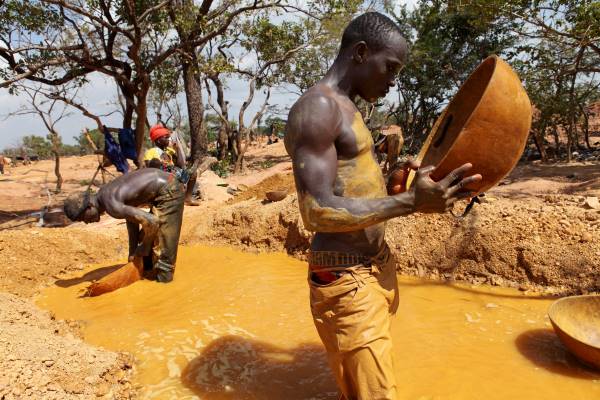
The Nile River and its tributaries play a significant role in Uganda’s gold mining, particularly in regions like Mubende and Busia. Placer gold deposits — gold found in riverbeds and floodplains — are extracted using panning and sluicing techniques.
In Mubende, artisanal miners work along streams feeding into the Nile basin, while larger operations employ mechanised methods. The Nile’s proximity to gold-rich regions in Uganda facilitates transportation and processing, though environmental concerns including mercury contamination threaten water quality.
The government’s efforts to formalise the sector, combined with growing global demand for gold at historically elevated prices, have positioned Uganda as the leading emerging gold hub in East Africa.
Gold Mining Methods in Uganda
Artisanal and Small-Scale Gold Mining in Uganda (ASM)
Artisanal and small-scale gold mining (ASM) in Uganda is the most common form of gold extraction, particularly in areas like Mubende, Karamoja, and Busia.
Over 90% of Uganda’s gold production comes from the ASM sector, employing an estimated 190,000 people across the country’s gold-producing regions.
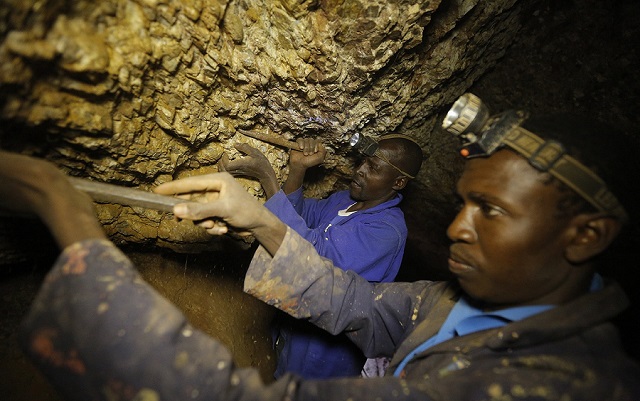
ASM miners in Uganda use manual panning, sluicing, and rudimentary tools such as shovels and sieves to extract gold from riverbeds or shallow hard-rock deposits.
While ASM provides employment for thousands, it poses environmental challenges including river siltation, deforestation, and soil erosion. Safety risks are significant, with exposure to collapsing pits, poor ventilation in underground workings, and limited use of protective equipment.
The Uganda government’s formalisation of artisanal gold mining through the DGSM (Directorate of Geological Survey and Mines) licensing framework and ongoing miner registration programmes is gradually bringing more ASM production into the documented supply chain that supports Uganda’s record export figures.
Large-Scale Industrial Gold Mining in Uganda
Large-scale gold mining in Uganda involves mechanised operations with heavy machinery, extraction plants, and processing facilities. Companies such as African Gold Refinery source ore from licensed mines and refine it to high purity for export.
This method is more efficient and produces higher yields but requires substantial capital investment and adherence to strict environmental regulations — including waste management, water treatment, and land rehabilitation.
Gold Mining Techniques Used in Uganda
Common gold extraction techniques in Uganda include panning, sluicing, dredging, and underground hard-rock mining. Panning and sluicing dominate artisanal operations in Mubende and Karamoja. Dredging and underground mining are used in industrial settings. Each technique carries specific environmental and safety considerations.
Uganda Gold Production and Economic Impact —2026
Annual Gold Production in Uganda
Uganda’s gold production has seen significant growth in recent years. The country produced approximately 3,200 kilograms of gold from domestic mines in 2022 — but the total gold flowing through Uganda’s formal export channels vastly exceeds this figure due to cross-border inflows from the DRC, South Sudan, Tanzania, and Kenya.
The newly operational Wagagai Gold Mining Project in Busia processes 5,000 tons of ore daily and is projected to produce approximately 1.2 metric tonnes annually from domestic Ugandan ore alone — adding significantly to total formal supply chain volume.
Contribution of Gold Mining to Uganda’s GDP and Exports
Gold mining’s contribution to Uganda’s economy is extraordinary by any measure. In 2025, Uganda recorded $5.8 billion in gold export earnings — a new national record and a figure that positions gold as Uganda’s dominant source of foreign exchange by an enormous margin.
The trajectory tells the story: Uganda earned $514 million from gold exports in 2016, $1.6 billion in 2019, $1.819 billion in 2020, $2.3 billion in 2023, and $5.8 billion in 2025 — a more than ten-fold increase in under a decade. In the first five months of 2025 alone, the country recorded $1.91 billion in gold export earnings.
Employment in Uganda’s Gold Mining Sector
The gold mining sector in Uganda provides employment to thousands of Ugandans, especially in regions like Karamoja, Mubende, and Buhweju.
The ASM sector alone employs an estimated 190,000 people. Large-scale projects like Wagagai are expected to create 3,000 additional jobs in Busia’s local economy.
Uganda’s Gold Mining Role in Foreign Exchange
Gold has emerged as Uganda’s leading source of foreign exchange — a structural shift of enormous economic significance. Uganda’s FATF grey-list removal in 2025 has further enhanced the country’s credentials as a legitimate, internationally compliant gold trading hub, attracting additional institutional buyers.
Uganda Gold Price Today — May 2026
The gold price in Uganda today reflects the international LBMA spot price converted to Ugandan Shillings (UGX). In stark contrast to the $60–$80/gram figures referenced in earlier versions of this article, gold prices in Uganda in 2026 have more than doubled:
Current Gold Price in Uganda — May 2026
| Karat | Per Gram (UGX) | Per Gram (USD) | Per oz (USD) | Per kg (USD) |
|---|---|---|---|---|
| 24K (999) | UGX 554,069 | ~$143–$152 | ~$4,452–$4,524 | ~$143,000–$152,000 |
| 22K (916) | UGX 492,030 | ~$131–$139 | ~$4,074–$4,324 | ~$131,000–$139,000 |
| 18K (750) | UGX 402,570 | ~$107–$112 | ~$3,328–$3,482 | ~$107,000–$112,000 |
Based on 1 USD = 3,758–3,785 UGX as of May 2026 and LBMA gold spot of approximately $4,450–$4,524/oz. The all-time high gold price in Uganda in the last year was UGX 636,532 per gram (24K), recorded on January 29, 2026.
Previous price references in this article ($60–$80/gram) reflected 2021–2024 market conditions and are now significantly outdated.
Gold has appreciated over 80% in USD terms and over 45% in UGX terms compared to the figures cited in earlier versions of this guide.
Why the Gold Price Difference Between Artisanal and Export Markets
The historic price gap between artisanal mining communities in Uganda and international export prices has narrowed considerably as formalisation has progressed.
In 2021, local prices in artisanal markets like Rupa in Karamoja were around UGX 7,000 (approximately $2.50) for 0.1 grams — dramatically below international rates.
Today, formalised ASM gold flowing through DGSM-licensed aggregators commands prices much closer to international LBMA-referenced rates, reflecting the improved supply chain structure Uganda has built over the past five years.
Gold Mining in Mubende, Uganda — The Industry’s Central Hub
Gold mining in Mubende — located in central Uganda — is a cornerstone of the country’s gold industry. Mubende is renowned for its rich gold reserves, particularly in areas like Bukuya and Kisita. The region hosts a mix of artisanal and semi-industrial mining, with an estimated 40,000–60,000 miners active before a significant eviction in 2017.
These evictions, ordered by President Yoweri Museveni, aimed to curb illegal mining and environmental damage, displacing thousands of artisanal miners in favour of licensed companies like AUC Mining.
Artisanal Gold Mining in Mubende
Artisanal gold mining in Mubende dominates the region’s production profile. Miners use rudimentary tools — pans, sluices, and shovels — to extract gold from riverbeds and shallow deposits along streams feeding the Nile basin. The Bukuya prospect, covering 202 square kilometres, is particularly active, with 60–80 artisanal workers mining over 600 metres of prospective strike.
However, artisanal miners in Mubende face significant challenges: lack of proper equipment, safety hazards, limited access to licensed land, and restricted mine sites following 2017 evictions.
Miners like Jalia Namatovu, displaced in 2017, struggle to find viable mining sites due to restricted access and high costs for geological surveys.
Large-Scale Gold Mining Companies in Mubende
Large-scale gold mining in Mubende is growing, with companies like eMetals Limited acquiring exploration licences (including EL00379) to develop the Mubende Gold Project.
This project targets metasediments and deformation zones hosting gold veins, indicating significant untapped potential in Uganda’s most active gold-producing district.
Mubende Gold Miners — a registered local Ugandan company — is another key player focusing on ethical and sustainable mining practices while collaborating with artisanal miners to improve livelihoods.
Challenges in Mubende’s Gold Mining Sector
Environmental degradation from artisanal mining — including deforestation, water pollution, and land degradation — remains a persistent challenge. Mercury use in gold extraction poses health and environmental risks.
Evictions and conflicts continue to create tension between artisanal miners and licensed companies. The 2017 evictions displaced thousands, with some mining families alleging that companies like AUC Mining restricted access to water sources.
Smuggling remains pervasive — Mubende is a hub for illicit gold trade, with gold smuggled from the DRC passing through the region into Kampala and Entebbe for export.
Despite these challenges, Mubende remains Uganda’s most attractive gold investment destination, with rich deposits drawing companies including Simba Gold (exploration permits in Kitumbi and Bukuya) and international exploration companies.
List of Gold Mining Companies in Uganda — 2026
The list of gold mining companies in Uganda includes both local and international players, reflecting the sector’s extraordinary diversity. Below is a compilation of key companies operating in 2025–2026:
Wagagai Mining Limited — Busia, Eastern Uganda
Wagagai Mining Ltd is a Chinese-owned company and one of Uganda’s most significant mining investments, with a $60 million investment in a gold mine and refinery in Busia.
Wagagai operates in a free-port zone exempt from import and export taxes and is expected to create 3,000 jobs in the region. The company has discovered 30 million tonnes of gold ore in Busia’s greenstone belt — one of Uganda’s most compelling geological discoveries.
Wagagai’s refinery processes 5,000 tonnes of ore daily, producing LBMA-standard gold bars for international export.
Mubende Gold Miners — Mubende and Karamoja
Mubende Gold Miners is a registered Ugandan company operating under the National Mining Act, specialising in high-quality gold bars, nuggets, and dust. It emphasises ethical sourcing and community support, collaborating with artisanal miners to improve livelihoods while meeting DGSM documentation requirements.
Vangold — West Nile Region, Mubende, and Other Areas
Vangold is a Canadian company with interests in eight mineral properties across Uganda, including Mubende, through subsidiaries including African Mineral Fields Ltd. Vangold operates in the Kilo Moto goldfields, with licences covering 287 square kilometres of highly prospective terrain.
Trade Panel International Limited — Kampala, Mubende, DRC
Trade Panel International Limited is a gold and timber production company sourcing gold from Uganda and the DRC for export to the Middle East, America, and Asia. It supports local communities through charity initiatives and operates with DGSM-licensed supply chain documentation.
Simba Gold — Mubende (Kitumbi and Bukuya)
Simba Gold is a foreign investment company with exploration permits in Mubende, focusing on both artisanal and commercial mining in Uganda’s most productive gold district.
Jan Mangal — Karamoja
An Indian-owned company engaged in early-stage gold exploration in Karamoja, Uganda’s second most significant gold-producing region, with a focus on community engagement and responsible sourcing.
Kassanda Mines — Uganda Nationwide
A Ugandan-owned company involved in artisanal and small-scale mining, supplying gold to refiners and exporters in Uganda and Kenya with DGSM-documented supply chains.
Busia Gold Refinery — Busia
While primarily a refinery, Busia Gold Refinery sources gold from mines across Uganda, supporting traceable gold trade and adding value to Uganda’s export profile.
Gold Sales Investment Uganda (GSI) — Kampala
A minerals trading company specialising in gold mining, extraction, purification, and distribution, emphasising environmental responsibility, DGSM compliance, and transaction transparency.
Africa Gold Refinery (AGR) — Entebbe
Africa Gold Refinery Ltd in Entebbe is one of East Africa’s most significant gold processing facilities, producing LBMA-standard certified bars from Uganda’s artisanal supply chain for export to the UAE, Europe, and Asia.
The Market for Gold in Uganda — 2026
The gold market in Uganda is vibrant, driven by both domestic and international demand:
ASM Sector Dominance: Over 90% of Uganda’s gold production comes from ASM, employing an estimated 190,000 people. These miners use traditional methods in regions like Mubende and Buhweju, feeding gold into the licensed aggregator network.
Large-Scale Mining: Companies like Wagagai and Vangold employ mechanised methods, including underground mining, to extract gold from hard-rock deposits with full DGSM documentation.
Gold Trading and Export: Licensed dealers and refineries — including AGR in Entebbe and Busia Gold Refinery — process and export gold to the UAE (primary destination), Europe, and Asia. The UAE absorbs the largest share of Uganda’s gold exports.
Domestic Demand: Growing demand for gold jewellery in Uganda is creating opportunities for goldsmith businesses in Kampala and major urban centres.
Buy Gold Bars Africa Limited operates within Uganda’s licensed supply chain, sourcing certified 24K gold bars with full DGSM documentation for delivery to international buyers worldwide.
Uganda Gold Exports — Record Performance and Key Statistics
Uganda gold exports have followed a trajectory of extraordinary growth:
| Year | Gold Export Value (USD) |
|---|---|
| 2016 | $514 million |
| 2019 | $1.6 billion |
| 2020 | $1.819 billion |
| 2023 | $2.3 billion |
| 2025 | $5.8 billion (record) |
The United Arab Emirates remains Uganda’s primary gold export destination, followed by Europe and Asia. Key drivers of Uganda’s gold export growth include:
New Refinery Infrastructure: Facilities including Wagagai‘s refinery in Busia and AGR in Entebbe have significantly increased Uganda’s domestic refining capacity, enabling more value-added exports.
Formalisation Programmes: DGSM’s ASM licensing and digital gold card initiative are bringing more production into documented channels, increasing formally exported volumes.
Regional Hub Status: Uganda’s strategic location means gold from the DRC, South Sudan, Rwanda, and Tanzania flows through Uganda’s export infrastructure — contributing to export volumes that exceed domestic production.
However, discrepancies between domestic production (approximately 3,200 kg in 2022) and massive export volumes confirm that a substantial portion of Uganda’s gold exports is sourced from neighbouring countries — raising ongoing concerns about conflict minerals and supply chain compliance that GoldBod, DGSM, and FATF monitoring are working to address.
Uganda Gold Mining Regulations and Licensing — 2026
Licensing Requirements for Ugandan Gold Miners and Exporters
Uganda’s mining sector is governed by the Mining and Minerals Act Cap. 159, which mandates that all mining operations — whether artisanal or industrial — obtain licences from the Ministry of Energy and Mineral Development (MEMD) through the DGSM. Exporters must secure separate export permits to ensure supply chain traceability and compliance.
Key requirements for legal gold mining and export in Uganda:
- Mineral dealer’s licence from DGSM for all gold buyers and traders
- Export permit from DGSM for each consignment leaving Uganda
- Assay certificate from DGSM-approved laboratory confirming purity and weight
- URA tax clearance confirming payment of all export levies ($200/kg)
- AML/KYC documentation including source of funds and beneficial ownership
Monitoring ASM vs Industrial Gold Mining in Uganda
The government monitors artisanal and small-scale gold mining through DGSM licensing and local authority oversight. While ASM provides livelihood for hundreds of thousands of Ugandans, it often operates informally — creating challenges for oversight, supply chain traceability, and revenue collection.
Industrial gold mining in Uganda — exemplified by Wagagai’s Busia operation — is more structured with formal compliance frameworks but requires substantially larger capital investment.
Risks of Illegal Gold Mining and Smuggling in Uganda
Illegal mining and gold smuggling remain significant challenges. In the 2023/24 financial year, approximately 96.5% of gold exports were conducted without the necessary permits — a figure that has driven Uganda’s aggressive DGSM formalisation push and digital gold card programme, designed to create what analysts describe as the world’s first fully traceable artisanal gold supply chain.
Challenges and Opportunities in Uganda’s Gold Mining Sector
Challenges
Environmental Impact: Mercury use and deforestation harm ecosystems, particularly near the Nile and its gold-bearing tributaries in Mubende and Busia.
Smuggling and Illicit Trade: Uganda’s role as a regional gold hub creates ongoing challenges distinguishing documented from undocumented gold flows.
Artisanal Miner Displacement: Evictions and restricted access to licensed land continue to marginalise small-scale miners in Mubende and Karamoja.
Regulatory Gaps: Informal trade and tax evasion — evidenced by the 96.5% permit non-compliance figure — reduce government revenue despite record export volumes.
Opportunities
Investment Potential: Uganda’s confirmed 31 million tonnes of gold ore reserves and the expanding DGSM licensing framework attract international mining investment.
Formalisation Through the Mining and Minerals Bill: The revised Mining and Minerals Bill and Uganda’s active EITI (Extractive Industries Transparency Initiative) membership aim to enhance transparency, sustainability, and revenue capture.
Value Addition Through Refining: Investments in refining capacity — Wagagai’s Busia refinery, AGR in Entebbe — allow Uganda to export higher-value refined gold bars rather than raw doré.
Job Creation at Scale: Projects like Wagagai’s mine promise thousands of jobs in historically underemployed regions.
Conclusion — Gold Mining in Uganda’s Extraordinary 2026 Position
Gold mining in Uganda is a dynamic and rapidly growing industry, with Mubende as a key hub due to its rich deposits and active artisanal and large-scale operations. The list of gold mining companies in Uganda — including Wagagai, Mubende Gold Miners, Vangold, AGR, and Trade Panel International — highlights the sector’s depth and diversity.
The market for gold in Uganda is thriving, driven by global demand and a supply chain infrastructure that is visibly formalising. Uganda’s gold export record of $5.8 billion in 2025 underscores the country’s role as East Africa’s dominant gold trading hub.
With gold prices in Uganda at UGX 554,069 per gram ($143–$152 USD) for 24K in May 2026 — dramatically above the $60–$80/gram figures from earlier reference periods — Uganda’s gold sector is operating at historically unprecedented value levels.
As Uganda continues to formalise its mining sector, invest in refinery infrastructure, and address the challenges of smuggling and environmental protection, the industry holds immense potential to drive sustained economic growth.
Uganda’s strategic location along the Nile River, its extraordinary mineral wealth, and its improving regulatory framework combine to create a gold sector that is only beginning to realise its full potential.
Secure your investment with high-purity gold sourced directly from Uganda’s licensed mines. Contact Buy Gold Bars Africa Limited today for verified gold bars, coins, or bullion — certified 24K gold at competitive LBMA-referenced pricing with full DGSM documentation, independent SGS assay certification, and insured international delivery.
📞 +256 707 585144 | 📲 WhatsApp: +256 707 585144 | 🌐 buygoldbarsafrica.com