Gold Ore: What It Is, Types, Processing & How to Identify It
Gold ore is naturally occurring rock or sediment that contains gold, usually in amounts far too small to see, mixed with other minerals like quartz, pyrite, and sulfides, and it has to be crushed, processed, and chemically treated before any of that gold can be recovered.
It’s the raw material gold bars and jewelry are ultimately made from, but ore itself is not something retail buyers purchase the way they buy refined gold bars or coins; ore is sold under contract to mills, smelters, and refineries equipped to process it, not shipped by the ton to individual international buyers.
This guide covers what gold ore actually is, the main types geologists classify it into, how it’s processed into refined gold, its chemical composition, how to identify it, and honest answers to what ore is actually worth.
What Is the Ore of Gold?
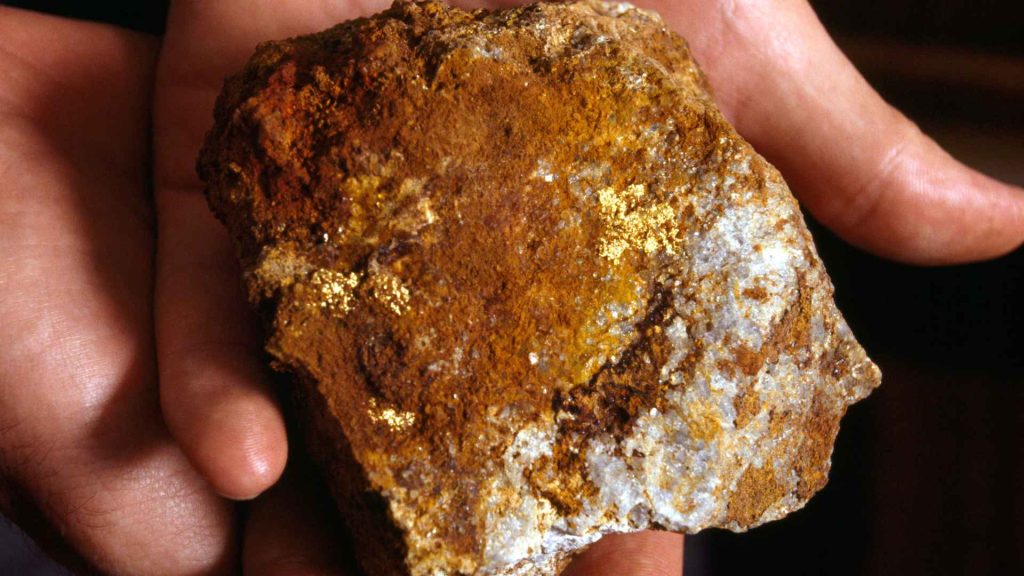
Gold ore is rock containing a high enough concentration of gold to be worth mining and processing. Unlike refined gold bars or nuggets, which are purified and shaped, ore is the unprocessed natural form: a mix of gold particles (often microscopic) embedded in quartz, carbonate minerals, chlorite, white mica, and sulfide minerals like pyrite and arsenopyrite.
Ore value depends entirely on its grade, measured in grams of gold per tonne of rock (g/t). A grade of even a few grams per tonne can be economically mineable at industrial scale, because large volumes of ore are processed at once; a grade that would be unremarkable in a single rock sample becomes valuable only in bulk, processed through purpose-built milling and extraction circuits.

Gold Ore Name and Formula
Gold itself is a chemical element, symbol Au (from the Latin aurum), atomic number 79. In its native form, found in most gold ore, it exists as the pure metal, not as a chemical compound, so native gold has no chemical “formula” in the way a compound like quartz (SiO₂) does.
That said, gold does occasionally occur as part of actual mineral compounds within certain ores, most notably gold telluride minerals:
| Mineral | Formula |
|---|---|
| Calaverite | AuTe₂ |
| Sylvanite | (Au,Ag)Te₄ |
| Krennerite | (Au,Ag)Te₂ |
These telluride ores are a specific, less common ore type (covered below) and require different processing than ordinary native-gold ore.
Main Types of Gold Ore
Gold ore is classified primarily by how the gold behaves during extraction, which determines the processing route needed:
Free-milling ore: gold that can be extracted with conventional cyanide leaching, with no complex pre-treatment needed. The most common and economically straightforward type.
Refractory ore: gold is physically locked inside sulfide minerals like pyrite or arsenopyrite, so cyanide alone can’t reach it. Requires pre-treatment, roasting, pressure oxidation, or bio-oxidation, before cyanidation will work.
Oxide ore: ore where the original sulfide minerals have weathered and oxidized near the surface, generally making gold easier to extract via standard cyanidation than the sulfide ore beneath it.
Carlin-type ore: extremely fine, often microscopic gold disseminated through sedimentary rock, named for Nevada’s Carlin Trend where this ore type was first extensively studied. Frequently refractory and carbon-bearing.
Alluvial (placer) ore: loose gold particles or nuggets concentrated in riverbeds and stream sediment through natural erosion, typically recovered by panning, sluicing, or dredging rather than hard-rock mining.
Telluride ore: gold chemically bound within telluride minerals like calaverite and sylvanite, requiring specific processing to break down the telluride compound before gold can be recovered.
Skarn-hosted ore: gold occurring within skarn, rock formed where magma has chemically altered surrounding limestone or carbonate rock, often found alongside other metals like copper or iron.
What Are the 7 Types of Gold Ore?
There’s no single universally fixed list, geologists classify ore by several overlapping criteria, but the seven types most commonly distinguished in mining literature are the ones above: free-milling, refractory, oxide, Carlin-type, alluvial, telluride, and skarn-hosted. Some classifications merge or split these differently depending on whether they’re organized by metallurgical behavior (free-milling vs. refractory) or by geological setting (alluvial vs. skarn vs. Carlin-type), so you may see slightly different groupings elsewhere.
Common Processing Methods
Turning ore into refined gold follows a consistent sequence, though the specifics vary by ore type:
- Exploration and sampling: geological mapping, soil sampling, and geophysical surveys identify viable deposits before any mining begins.
- Mining: open-pit mining for shallow deposits, or underground mining (tunnels and shafts) for deeper ore bodies.
- Crushing and grinding: ore is mechanically reduced to fine particles to liberate gold from surrounding rock.
- Pre-treatment (refractory ore only): roasting, pressure oxidation, or bio-oxidation breaks down sulfide minerals that would otherwise block extraction.
- Extraction: typically cyanide leaching, where a cyanide solution dissolves gold out of the crushed ore, followed by recovery via activated carbon adsorption, zinc precipitation (the Merrill-Crowe process), or electrowinning.
- Refining: recovered gold is purified to remove remaining impurities, producing bars or bullion at purities up to 99.99% (24K).
- Tailings management: waste rock and processing byproducts are stored and managed to limit environmental impact, an increasingly scrutinized part of the process given cyanide and heavy-metal risks.
How to Identify Gold Ore
A few preliminary checks can suggest whether a rock might contain gold, though none of them are conclusive on their own:
- Visual inspection: genuine gold is a warm, metallic yellow and doesn’t tarnish. Quartz veining and pyrite (“fool’s gold”) often occur alongside real gold, so their presence is a hint, not proof.
- Magnet test: gold is not magnetic. If a strong magnet attracts the rock, you’re likely looking at iron-bearing minerals or magnetic pyrite, not gold.
- Streak test: rub the sample across unglazed ceramic. Real gold leaves a yellow streak; pyrite leaves a greenish-black one.
- Weight and density: gold is notably dense; a piece that feels unusually heavy for its size is worth further testing.
None of these replace a professional assay. Visual and home tests are only preliminary screening; a certified assay lab using fire assay or XRF analysis is the only reliable way to confirm gold content and grade.
How Much Is 1 Gram of Gold Ore Worth?
This is where ore pricing is most commonly misunderstood. Ore is not priced like refined gold, and a price near the refined gold rate is a red flag, not a bargain.
The gold content of a sample of ore is only worth a fraction of the live gold price, because:
- Most of the material by weight isn’t gold at all; it’s host rock.
- Extracting that gold requires crushing, chemical processing, and refining, all of which cost money and reduce the net value to anyone buying raw ore.
- Recovery is never 100%; some gold is inevitably lost in processing.
As a rough illustration: ore running 20 grams of gold per tonne (a genuinely high grade) contains, by definition, 20 grams of gold spread across 1,000,000 grams of rock. The contained gold’s raw value at the live spot price gives you a ceiling on what that tonne could theoretically be worth once fully refined, and the actual price anyone would pay for the unrefined ore itself sits well below that ceiling, discounted for processing costs, recovery losses, and the buyer’s margin.
This is exactly why retail international ore sales are a common scam setup. A legitimate buyer of raw ore is a mill or refinery with the equipment to process it, operating under a supply contract, not an individual purchasing a sealed sack of rock by courier. If you’re offered “high-grade gold ore” priced anywhere near the refined gold rate, treat it as a serious warning sign.
Gold Ore Price: What Actually Determines It
Where ore is legitimately bought and sold (between miners and processing facilities), price depends on:
- Grade (grams per tonne): the single biggest driver of value.
- Recoverability: free-milling ore is worth more per gram of contained gold than refractory ore, since it costs less to process.
- Contaminants: arsenic, mercury, and other impurities can reduce processing value or add environmental compliance costs.
- Transport and processing logistics: distance to the nearest capable mill or refinery affects net value significantly.
There’s no meaningful “retail price per gram” for raw gold ore the way there is for refined bars, because ore isn’t a standardized, fungible retail product.
Gold Ore vs. Gold Nugget
These are often confused but are genuinely different:
| Gold Ore | Gold Nugget | |
|---|---|---|
| Form | Gold mixed with rock, often microscopic | Visible, naturally occurring solid gold |
| Processing needed | Crushing, chemical extraction | Little to none; can be sold close to as-is |
| Typical source | Hard-rock mining | Riverbeds, alluvial deposits |
| Market | Sold to mills/refiners under contract | Traded directly to dealers, collectors, investors |
If you’re interested in owning gold directly rather than raw, unprocessed material, gold nuggets and gold dust are the forms of naturally-occurring gold actually suited to individual buyers, since they require no industrial processing to have clear, assessable value.
Where to Actually Buy Gold
For investors and buyers, refined, certified gold is the standard and safe route, not raw ore. Buy Gold Bars Africa supplies certified 24K gold bars, gold nuggets, and gold dust, each with independent assay certification, from licensed operations.
See our safe buying guide and why cheap African gold offers can be dangerous before considering any offer involving raw or unrefined material.
Gold Ore FAQs
What is gold ore? Natural rock or sediment containing gold, usually in amounts too small to see, mixed with minerals like quartz, pyrite, and sulfides, requiring crushing and chemical processing before the gold can be recovered.
Is gold ore pure gold? No. Gold ore is a mixture of gold and surrounding rock and minerals. Purity depends on grade (grams of gold per tonne), and even high-grade ore is overwhelmingly non-gold material by weight.
What are the main types of gold ore? Free-milling, refractory, oxide, Carlin-type, alluvial, telluride, and skarn-hosted are the types most commonly distinguished, classified by how the gold behaves during extraction and the geological setting it’s found in.
What is gold ore’s chemical formula? Native gold itself has no compound formula; it’s the element Au. Some gold ores contain gold telluride minerals with real formulas, such as calaverite (AuTe₂) and sylvanite ((Au,Ag)Te₄).
How much is 1 gram of gold ore worth? Significantly less than 1 gram of refined gold, since most of any ore sample by weight isn’t gold, and extracting what gold is present costs money. There’s no standard retail price per gram for raw ore; value depends on grade, recoverability, and processing costs.
How do I identify gold ore? Preliminary checks include visual inspection, a magnet test (gold isn’t magnetic), and a streak test on unglazed ceramic. None of these are conclusive; a certified assay lab is the only reliable confirmation.
Can I buy gold ore as an investor? It’s not a typical or recommended route for individual investors. Legitimate ore sales happen between miners and processing facilities under contract. Certified refined gold bars, nuggets, or dust are the appropriate form for individual buyers.
Buy Certified, Refined Gold Instead
Skip the risks of raw ore and buy certified, assay-verified gold directly. Contact Buy Gold Bars Africa Ltd, message us on WhatsApp at +256 707 585144, or read about our company.