Why Is Gold Cheap in Uganda? 7 Real Reasons Explained (2026)
Why is gold cheap in Uganda? It is one of the most searched questions among investors, gold traders, and international buyers who keep seeing Uganda listed alongside countries like the DRC and Mali as a source of competitively priced gold.
The answer involves geography, geology, government policy, market structure, and Uganda’s unique position as a transit hub for one of Central Africa’s most productive gold-producing regions.
Here is the complete answer — seven clear reasons why gold prices in Uganda consistently come in below equivalent products from European, Gulf, or North American bullion markets, and why serious buyers are paying attention.
7 Reasons why is gold cheap in Uganda:
1. Direct Access to Artisanal Mining Sources — No Middlemen
The single most important reason gold is cheap in Uganda is proximity to the source. Uganda has its own significant artisanal gold-producing regions — particularly Karamoja sub-region in the northeast, Mubende district, and the Busia area along the Kenya border — where hundreds of thousands of small-scale miners extract alluvial and hard-rock gold using manual methods.
When you buy gold in Uganda, you are often just one or two steps removed from the miner who dug it out of the ground. There is no Swiss refinery adding a processing margin, no London bullion dealer adding a distribution premium, no retail chain adding a retail markup.
The cost structure is radically compressed. Every layer of intermediary removed between mine and buyer is a layer of premium that does not appear in the final price.
Direct deals with miners in Uganda’s gold regions offer prices competitive with the lowest in Africa, making Uganda one of the most cost-effective markets for 24K gold investment on the continent.
2. Low Mining and Operational Costs
Artisanal and small-scale mining in Uganda operates at extraordinarily low cost compared to the industrial mining that dominates production in South Africa or Ghana.
Equipment is basic — pans, sluices, hand-dug pits, and simple crushing mills — which means capital costs are minimal and operational expenses per gram of gold produced are a fraction of what large-scale mines incur.
Labour costs in Uganda are also significantly lower than in more industrialised mining economies. When the cost of extracting a gram of gold from the ground is low, the price at which it enters the market is low.
This is the structural foundation of Uganda’s competitive gold pricing — the economics of production feed directly into the economics of purchase.
African markets close to mines often offer premiums as low as 1–3% above the LBMA spot price, due to proximity to mines and lower refining costs — a structural advantage that Uganda shares with the DRC and Mali.
3. Uganda as a Gateway for DRC Gold
This is perhaps Uganda’s greatest structural advantage as a gold market: its position as the primary transit route for gold flowing out of eastern DRC. The Democratic Republic of Congo is one of the world’s largest gold-producing nations, with artisanal miners in Ituri, North Kivu, and South Kivu generating enormous volumes of high-purity gold.
Much of this gold crosses into Uganda through the border towns of Busia, Mpondwe, and Oraba before entering the formal Ugandan trading system.
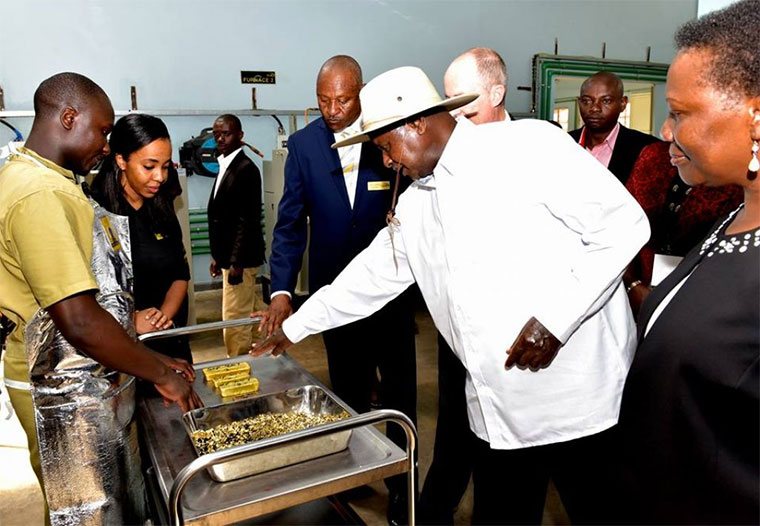
Africa Gold Refinery, established in 2017 as Uganda’s first bullion processor, now operates alongside several additional refineries handling both domestic gold production and shipments from the neighbouring Democratic Republic of Congo.
This cross-border supply means Uganda’s gold market is effectively larger than Uganda’s own production figures suggest. The abundance of supply — from both Ugandan artisanal mines and Congolese cross-border flows — keeps competition among dealers intense and prices tight. For buyers, more supply in a competitive market means lower premiums above spot.
4. Favourable Tax and Export Policy Structure
The Uganda Revenue Authority waived VAT on refined gold exports in 2023, boosting the Uganda gold economy, with only a 0.5% export levy applying to gold shipments.
Compare this to markets like India — where gold attracts a 10% import duty plus 3% GST plus making charges — or even to European countries where VAT treatment of investment gold, while often exempt, adds administrative cost. Uganda’s lean tax environment on gold means the price buyers pay is not inflated by layers of fiscal overhead.
Lower taxes mean lower effective prices. It is that simple — and it is a deliberate policy choice by the Ugandan government to keep the country’s gold market competitive and attract international buyers.
5. Growing Domestic Refinery Infrastructure
Uganda has invested significantly in its domestic gold refining capacity since the mid-2010s. Uganda’s expanding mining sector, anchored by the 2025 commissioning of large-scale processing facilities, provides reliable domestic supply sources that reduce import dependency.
When refining happens domestically rather than requiring export to Switzerland, South Africa, or Dubai for processing, the cost of converting raw gold into investment-grade bars is lower. These savings flow through the supply chain to buyers.
6. Currency and Exchange Rate Dynamics
Gold is priced internationally in US dollars. In Uganda, where the Ugandan Shilling (UGX) has historically depreciated gradually against the dollar, local sellers of gold are effectively pricing in USD terms and converting to UGX.
When the UGX weakens, gold appears more affordable in shilling terms — but even in pure USD terms, the combination of low production costs and minimal intermediary margins means Uganda gold prices per gram remain competitive against Western retail equivalents.
Since gold is globally traded in USD, fluctuations in the Ugandan Shilling’s strength against the dollar directly affect local gold prices in UGX — but Uganda’s low production costs help the country maintain competitive USD pricing regardless of currency movements.
7. Competitive Dealer Market in Kampala
Kampala’s gold trading community is dense, competitive, and growing. Multiple licensed dealers, refineries including Africa Gold Refinery, and export agents operate in close proximity — particularly around Kampala’s commercial districts and near Entebbe International Airport, which is a primary export gateway for certified gold shipments.
Competition is price-suppressing. When dozens of dealers are bidding for the same supply and competing for the same buyers, margins compress. The result is tighter premiums above spot than buyers typically encounter in less competitive markets.
What Does Cheap Gold in Uganda Mean for Buyers in 2026?
It means genuine savings at scale. At current gold spot prices of approximately $143–$163 USD per gram for 24K gold in Uganda — depending on purity, form, and purchase volume — buyers sourcing through a licensed Ugandan dealer consistently access gold at lower effective premiums than equivalent products from European or Gulf bullion markets.
The important caveat is that cheap does not mean unverified. The same market dynamics that produce competitive gold prices in Uganda also attract fraudulent operators offering gold that is counterfeit, misrepresented in purity, or illegally sourced.
The price advantage of the Ugandan market is only realised safely when you buy from a licensed, documented, compliant supplier.
Buy Cheap Gold in Uganda Safely with Buy Gold Bars Africa Ltd
Buy Gold Bars Africa Ltd is a licensed, fully documented gold supplier operating across Uganda’s key producing and trading regions — Kampala, Entebbe, Mubende, Busia, and Karamoja. Every gram we sell comes with:
- Certified assay report from an accredited independent laboratory
- Certificate of origin confirming Ugandan or DRC provenance
- Export permit from Uganda’s Ministry of Energy and Mineral Development
- Full AML/KYC compliance documentation
- Insured international shipping via DHL Express or Brinks to your destination worldwide
You get the competitive pricing that makes Uganda one of the cheapest countries to buy gold in Africa — plus the documentation that makes it safe, legal, and internationally tradeable.
Contact Buy Gold Bars Africa Ltd today for a live, spot-referenced price quote on Uganda gold. WhatsApp, email, or visit our Kampala office to get started.