A Comprehensive Guide to Top 10 Richest Mines in South Africa
Discover the top 10 richest mines in South Africa, exploring their vast mineral wealth, economic impact, and operational significance. From gold mines in South Africa to platinum, diamonds, and iron ore, learn about the key players like Mponeng Gold Mine, South Deep, and Sishen Iron Ore Mine, driving South Africa’s mining industry.
South Africa, often referred to as the “Rainbow Nation,” is renowned for its abundant mineral resources, which have shaped its economy and global standing for over a century.
The country boasts some of the world’s richest and deepest mines in South Africa, producing a diverse array of minerals including gold, platinum, diamonds, iron ore, manganese, and chromium.
These resources have historically driven economic growth, contributing significantly to the nation’s GDP and export revenues.
With 16 commodities ranked among the top 10 globally, South Africa’s mining industry remains a powerhouse in the global mining sector, despite challenges like declining gold production and rising operational costs. Below is a complete guide to the top 10 richest mines in South Africa — ranked by reserves, annual output, and overall economic significance.
A Look at the 10 Richest Mines in South Africa;
1. Mponeng Gold Mine — The World’s Deepest Gold Mine in South Africa
Located in Gauteng near Carletonville, Mponeng Gold Mine is the world’s deepest gold mine, reaching depths of over 4 kilometers below the surface. Operated by Harmony Gold, which acquired it from AngloGold Ashanti in 2020 for approximately $200 million, Mponeng is a cornerstone of South Africa’s gold mining industry.
The mine sits within the Witwatersrand Basin, home to nearly a third of the world’s gold reserves. Mponeng’s proven gold reserves are estimated at 46 million ounces, making it one of the richest gold mines in the world by reserves. In 2020–2021, it processed 683,000 metric tons of ore, yielding 175,095 ounces of gold, with a target of 250,000 ounces annually.
Mponeng’s operations involve sequential grid mining, navigating complex geological conditions like thrust fracturing and hydrothermal activity.
The mine’s depth presents unique challenges, including high temperatures — up to 140°F — and seismic risks in deep-level gold mining, with low-magnitude earthquakes often triggered by blasting. Safety protocols and research, such as the JAGUARS project, aim to mitigate these risks.
Economically, Mponeng supports entire communities and industries, but its high production costs — $1,771 per ounce in 2022 — reflect the challenges of ultra-deep gold mining in South Africa. Its operational life is projected to continue until 2029, with potential extensions to deeper reserves.
2. South Deep Gold Mine — The World’s Largest Gold Mine by Reserves
South Deep Gold Mine, located 45 km southwest of Johannesburg in the Witwatersrand Basin, is the world’s largest gold mine by reserves, with 32.8 million ounces of proven gold reserves as of 2018.
Owned by Gold Fields, South Deep is also the seventh deepest mine globally, operating at depths up to 2,998 meters. In 2023, it produced 321,500 ounces of gold, contributing significantly to South Africa gold output, which accounts for 4.2% of global gold production
The mine’s vast reserves and high-grade ore make it a critical asset for gold mining in South Africa, despite a decline in the country’s overall gold production from 605 tonnes in 1994 to 133 tonnes in 2014.
South Deep employs advanced mechanized underground mining techniques to extract gold from the Ventersdorp Contact Reef and Upper Elsburg Reef.
Its operational lifespan is expected to extend to 2096, underscoring its long-term economic importance to South Africa’s gold sector. However, the mine faces challenges like margin squeezes due to rising costs at depth and a historical decline in gold prices.
Gold Fields, with a market capitalisation of $12.5 billion, continues to invest in sustainability and innovation to maintain South Deep’s profitability.
The mine’s contribution to South Africa’s GDP — estimated at $23.9 billion from gold mining in 2019 — highlights its economic significance.

3. Sishen Iron Ore Mine — One of the World’s Largest Open-Pit Iron Ore Mines
Situated 30 km from Kathu in the Northern Cape, Sishen Iron Ore Mine is one of the world’s largest open-pit iron ore mines, operated by Kumba Iron Ore, a subsidiary of Anglo American.
With reserves sufficient for a 14-year mine life, Sishen produced 27.42 million metric tons of iron ore in 2022. Since its inception in 1953, the mine has yielded over 900 million metric tons, with its first export in 1976.
Sishen’s high-grade hematite iron ore is primarily exported to East Asia and Europe, bolstering South Africa’s position as a leading iron ore supplier on the global market.
The mine’s economic impact is substantial, employing thousands and contributing to the 4% of global iron ore production attributed to South Africa
Kumba Iron Ore, with a market capitalisation of $10.01 billion, drives significant iron ore export revenues from South Africa, with iron ore accounting for a portion of the $282 billion in mineral exports. Sishen’s operations are supported by advanced logistics, including a dedicated rail line to the port of Saldanha.
However, challenges like regulatory changes and infrastructure constraints require ongoing investment in efficiency and sustainability.
4. Kusasalethu Gold Mine — Harmony Gold’s Flagship Deep-Level Operation
Kusasalethu Gold Mine, located 90 km west of Johannesburg near the Gauteng–North West border, is another of Harmony Gold’s flagship gold mining operations in South Africa.
One of the world’s deepest mines, it operates at depths up to 3.4 km, extracting gold from the Ventersdorp Contact Reef. Acquired from AngloGold Ashanti in 2001 for R1 billion, Kusasalethu has seen significant improvements, with a 33% increase in underground recovered grade and a 14% rise in gold production, leading to a 22% revenue increase in recent years.
The mine employs conventional underground mining methods and twin vertical shaft systems. Kusasalethu’s economic contributions include job creation and community development, though it faces challenges like labour disputes in South Africa’s gold mining sector and high operational costs due to its depth.
Its role in South Africa’s gold sector, which employs 119,075 workers despite a significant decline from 1994, underscores its importance.
The mine’s ability to maintain profitability in a declining gold market highlights Harmony Gold’s operational expertise in deep-level gold mining
5. Venetia Diamond Mine — South Africa’s Largest Diamond Mine
Located in Limpopo Province, Venetia Diamond Mine is one of South Africa’s largest diamond mines, operated by De Beers since 1992. Producing 34.6 million carats in 2022, Venetia is a key contributor to South Africa’s diamond mining industry, which ranks seventh globally.
The mine transitioned from open-pit to underground operations in 2022, following a $2.3 billion investment by De Beers to extend its operational life.
The underground diamond mining expansion at Venetia delivers up to 7 million metric tons of kimberlite ore annually, reinforcing the mine’s status as a high-value asset.
De Beers, historically funded by figures like Nathaniel Rothschild and led by Cecil Rhodes, controls much of South Africa’s diamond output. Venetia’s production of high-quality diamonds for export supports export revenues and local employment, though the diamond industry faces challenges from fluctuating global demand and synthetic alternatives.
The mine’s shift to underground mining demonstrates De Beers’ commitment to sustainability and long-term profitability.
6. Finsch Diamond Mine — South Africa’s Second-Largest Diamond Mine
Situated 165 km west of Kimberley in the Northern Cape, Finsch Diamond Mine is South Africa’s second-largest diamond mine by production. Operated by Petra Diamonds, Finsch is renowned for producing commercial-grade diamonds of +5 carats. Its underground operations target kimberlite pipes, yielding significant quantities of high-quality diamonds.
Finsch’s economic impact includes job creation and contributions to South Africa’s diamond export sector, which is largely controlled by De Beers. The mine’s operational efficiency and focus on high-value diamond production make it a key player in the global market.
However, like Venetia, Finsch faces challenges from market volatility and the need for continuous investment in technology to maintain competitiveness.
Its proximity to historical diamond fields in Kimberley ties it to South Africa’s rich mining heritage and the birthplace of modern diamond mining
7. Palabora Copper Mine — South Africa’s Top Copper Producer
Located 360 km northeast of Pretoria near Kruger National Park, Palabora Copper Mine is South Africa’s largest copper producer, yielding approximately 45,000 tonnes of copper annually.
Owned by a Chinese consortium including HBIS and Tewoo, Palabora has been operational since 1956. The mine also produces by-products like anode slimes, sulfuric acid, and uranium concentrates, adding to its economic value.
In 2020, it produced 45,000 tonnes of copper rod, primarily from its LIFT I block cave mine. Palabora’s contributions to South Africa’s copper exports and local employment are significant, though its remote location poses logistical challenges.
The mine’s diverse output and long operational history highlight its role in diversifying South Africa’s mineral portfolio beyond gold and diamonds.
8. Impala Platinum Mine — Heart of South Africa’s Global Platinum Dominance
Operated by Impala Platinum Holdings (Implats) in the Bushveld Igneous Complex, Impala Platinum Mine is a leading producer of platinum group metals (PGMs), which account for 59% of global PGM production.
South Africa is the world’s largest platinum producer, and Impala’s operations near Rustenburg in the North West Province are central to this dominance. The mine produces platinum, palladium, rhodium, nickel, and copper, with a market capitalisation of $9.33 billion for Implats.
Impala’s economic impact includes significant platinum export revenues from South Africa and employment, with thousands of workers engaged in its operations.
However, labour disputes and fluctuating PGM prices pose challenges. Implats’ focus on innovation and sustainability, including investments in renewable energy, positions Impala as a resilient player in South Africa’s platinum mining sector. The Rustenburg complex is among the most important platinum group metals mining operations in the world.
9. Kloof Gold Mine — Sibanye-Stillwater’s Deep-Level Witwatersrand Producer
Located in Gauteng, Kloof Gold Mine is a surface and underground gold mine owned by Sibanye-Stillwater, producing 262,190 ounces of gold in 2023.
Operating at depths up to 3.4 km, Kloof targets the Ventersdorp Contact Reef and Kloof Reef. Sibanye-Stillwater, with a market capitalisation of $7.8 billion, is a major player in South Africa’s gold and PGM mining sectors, contributing to the country’s 23% share of global platinum exports
Kloof’s high-grade gold ore and efficient operations make it a key contributor to South Africa’s gold output, though it faces similar challenges to other deep-level gold mines in South Africa, including high costs and seismic risks.
The mine’s role in job creation and export revenues underscores its economic significance to the Witwatersrand gold mining belt
10. Barberton Mines Complex — South Africa’s Oldest High-Grade Gold Mining Operation
The Barberton Mines complex in Mpumalanga, operated by Pan African Resources, comprises the Fairview, New Consort, and Sheba mines. Among the oldest and highest-grade gold mines in the world, Barberton has produced 11 million ounces of gold since the late 19th century.
With proven reserves of 1.4 million ounces and an annual gold production capacity of 80,000 ounces, the complex remains a significant contributor to South Africa’s gold sector.
Barberton’s high-grade gold reefs and long operational history highlight its importance, though its smaller scale compared to Mponeng or South Deep limits its output.
The complex supports local economies and demonstrates the enduring value of South Africa’s historic goldfields in Mpumalanga.
The Barberton Mines complex stands as proof that some of the world’s richest gold mining operations can maintain profitability over more than a century of continuous production.
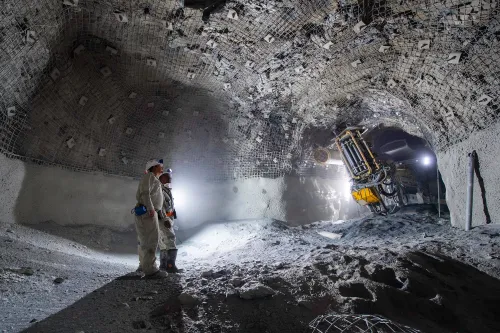
Top 10 Richest Mines in South Africa — Rankings Table by Annual Production & Estimated Revenue
The table below ranks the richest mines in South Africa by annual production, total reserves, and estimated annual revenue.
Values are approximate and based on recent industry data — update them with the latest 2026 statistics for accuracy. Note: revenue estimates use gold ~$1,850/oz, platinum ~$4,500/oz, and variable diamond values per carat.
Top 10 Richest Mines in South Africa — Production, Reserves & Estimated Revenue
| Rank | Mine Name | Province | Main Mineral | Annual Production | Total Reserves | Est. Annual Revenue (USD) |
| 1 | Mponeng | Gauteng | Gold | 0.7 million oz | 10 million oz | $1.3 billion |
| 2 | South Deep | Gauteng | Gold | 0.6 million oz | 32 million oz | $1.1 billion |
| 3 | Kloof | Gauteng | Gold | 0.5 million oz | 14 million oz | $950 million |
| 4 | Driefontein | Gauteng | Gold | 0.4 million oz | 12 million oz | $760 million |
| 5 | Rustenburg | North West | Platinum | 600,000 oz | 70 million oz | $2.7 billion |
| 6 | Impala Platinum | North West | Platinum | 500,000 oz | 50 million oz | $2.25 billion |
| 7 | Marula | Limpopo | Platinum | 200,000 oz | 20 million oz | $900 million |
| 8 | Bafokeng Rasimone | North West | Platinum | 150,000 oz | 15 million oz | $675 million |
| 9 | Cullinan Diamond Mine | Gauteng | Diamonds | 1.5 million carats | 50 million carats | $550 million |
| 10 | Beatrix | Free State | Gold | 0.3 million oz | 8 million oz | $570 million |
Economic and Social Impact of South Africa’s Richest Mines
South Africa’s mining sector accounts for 60% of the country’s exports and 18% of its $588 billion GDP, employing 493,000 workers as of 2007. Gold, platinum, iron ore, and coal alone contribute $282 billion in exports, with platinum and gold dominating global production from South African mines.
However, the South African gold mining industry faces systemic challenges, including a decline in gold output from 605 tonnes in 1994 to 133 tonnes in 2014, driven by margin squeezes and rising costs at depth. Job losses in South Africa’s mining sector have been significant, with 442,000 jobs lost since the late 1980s.
The richest mines in South Africa — like Mponeng, South Deep, and Sishen — are critical to sustaining employment and export revenues. Companies like Harmony Gold, Gold Fields, Anglo American, and De Beers invest in community development, healthcare, and education, mitigating some social impacts.
However, labour disputes, environmental concerns, and regulatory changes — such as the Black Economic Empowerment programme requiring 26% black ownership by 2014 — pose ongoing challenges for the sector.
Challenges and Future Prospects for South Africa’s Mining Industry
South Africa’s mining industry faces a systemic crisis, with 75% of gold mines unprofitable as of 2018 due to declining reserves and high production costs.
Deep-level gold mining in South Africa requires advanced technology and significant capital investment, yet the decay of research and development infrastructure has hindered competitiveness.
The Department of Mineral and Petroleum Resources, re-established in 2024, aims to address these issues through policy reforms and investment in sustainable mining practices in South Africa.
The future of the country’s richest mines lies in innovation, such as mechanized mining technology and renewable energy adoption.
Mines like Venetia and Sishen are transitioning to more sustainable operating models, while companies like Implats and Sibanye-Stillwater explore diversification into critical minerals like lithium and cobalt, aligning with global energy transition demands.
Top Gold and Platinum Mining Companies in South Africa in 2026
South Africa remains a global mining powerhouse, and in 2026, several companies lead the industry in production, innovation, and economic impact. Sibanye-Stillwater is a top performer, operating major gold and platinum mining operations in South Africa, including Driefontein and Beatrix, and driving sustainability initiatives.
Anglo American Platinum dominates the platinum group metals sector in South Africa with operations like Mogalakwena and Marula, producing some of the world’s highest-grade platinum.
Harmony Gold continues to be a key South African gold producer, managing mines such as Mponeng and Kloof with a focus on efficiency and safety.
Impala Platinum Holdings (Implats) stands out for its consistent platinum output from mines in the North West Province, while Northam Platinum contributes significantly to the country’s platinum supply with modern mining practices.
These top mining companies in South Africa not only supply global markets but also support local communities through employment, infrastructure, and corporate social responsibility programmes, cementing South Africa’s position as a leading mining nation in 2026.
FAQs About South Africa’s Richest Mines
Which is the richest mine in South Africa?
The Mponeng Gold Mine is considered the richest mine in South Africa, known for its exceptionally high-grade gold deposits. Located near Carletonville in Gauteng, it has consistently yielded significant gold output, making it one of the most profitable mines in the world and the world’s deepest gold mine in active operation.
How deep is the Mponeng mine?
The Mponeng Gold Mine depth reaches approximately 4 kilometers (13,123 feet) below the surface, making it the deepest gold mine in the world. Extreme temperatures and engineering challenges require advanced cooling and safety systems for miners working at such extraordinary depths.
Which South African mine produces the most platinum?
The Rustenburg Platinum Mine in South Africa is the leading producer of platinum. Operated by Anglo American Platinum, it accounts for a significant portion of global platinum production from South Africa, supporting both industrial applications and investment markets worldwide.
Can foreigners invest in South African mines?
Yes, foreign investment in South African mines is permitted. Foreign investors can invest in South African mining companies through licensed mining companies or joint ventures. Regulations require compliance with the Mineral and Petroleum Resources Development Act (MPRDA), ensuring legal ownership, environmental standards, and fair profit-sharing.
Conclusion: South Africa’s Top 10 Richest Mines and the Future of Mineral Wealth
South Africa’s top 10 richest mines — Mponeng, South Deep, Sishen, Kusasalethu, Venetia, Finsch, Palabora, Impala, Kloof, and Barberton — represent the backbone of the nation’s economy.
These mines produce vast quantities of gold, platinum, diamonds, iron ore, and copper, driving export revenues from South Africa’s mining sector and supporting hundreds of thousands of jobs.
Despite challenges like declining reserves, high production costs, and regulatory pressures, their continued operation and adaptation to modern demands ensure South Africa’s position as a global mining leader.
By investing in technology, sustainability, and community development, these mines will shape the future of South Africa’s mineral wealth for decades to come.
Understanding the richest mines in South Africa by mineral reserves and annual production is essential for any investor, analyst, or student of the global precious metals and minerals industry.