Impact of US Dollar on Gold Prices: Fascinating Insight 2026
Impact of US Dollar on Gold Prices: Among the many forces that drive gold prices, the US dollar stands out as the single most influential macro variable. The two share an inverse relationship that has persisted across decades and economic cycles: when the dollar rises, gold tends to fall, and when the dollar weakens, gold tends to climb.
Understanding this dynamic is essential for anyone tracking commodities, managing a portfolio, or simply trying to make sense of the global financial system.
This guide covers the mechanics of that relationship, the key drivers behind it, and the important exceptions that every investor should know.
Why Gold and the Dollar Move in Opposite Directions
The inverse relationship between gold and the US dollar rests on three interconnected pillars.
First, gold is priced in US dollars in every major market around the world. This means that when the dollar strengthens against other currencies, gold automatically becomes more expensive for foreign buyers — a British investor, a Japanese trader, or an Indian institution all face higher local-currency costs when the dollar is strong. That reduced affordability dampens international demand, applying downward pressure on the price. Conversely, a weaker dollar makes gold cheaper in foreign currency terms, stimulating demand and lifting prices.
Second, gold functions as an alternative store of value. When confidence in the dollar is high — when inflation is contained, the US economy is growing, and monetary policy is credible — investors see little reason to hold an asset that pays no yield.
But when the dollar’s purchasing power erodes or its credibility comes into question, gold becomes a natural refuge. It cannot be printed, it carries no counterparty risk, and it has held value across thousands of years of human history.
Third, there is the matter of opportunity cost. A strong dollar typically accompanies higher US interest rates. Holding gold means forgoing the yield available on Treasury bonds, money-market instruments, or savings accounts.
When rates are high, that forgone income is significant, and investors rotate away from gold. When rates are low — or negative in real terms — the opportunity cost of holding gold shrinks, making it far more attractive.
The DXY Dollar Index and Gold
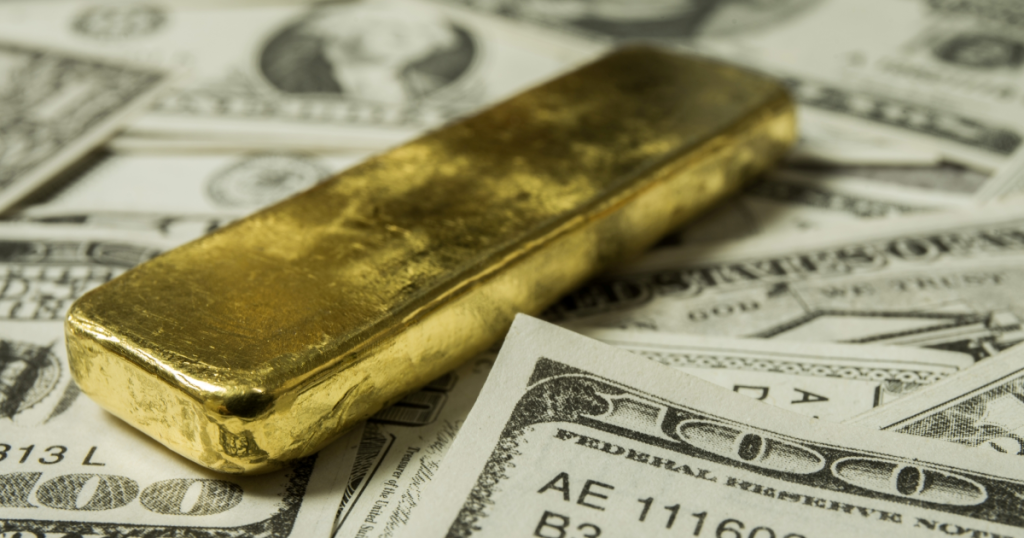
Traders and analysts routinely track the DXY — the US Dollar Index — alongside gold. The DXY measures the dollar’s value against a basket of six major currencies: the euro, Japanese yen, British pound, Canadian dollar, Swedish krona, and Swiss franc. Because the euro alone accounts for nearly 58% of the basket, moves in EUR/USD have an outsized influence on DXY.
The historical pattern is clear: DXY rising tends to coincide with gold falling, and vice versa. While the correlation is not mechanical — it can and does break down under certain conditions — it remains one of the most reliable directional signals in commodity markets.
Watching DXY alongside gold futures gives traders a quick read on whether dollar dynamics are supporting or suppressing the metal on any given day.
Key Macro Drivers at a Glance
The table below summarises the main macro events and their typical impact on both assets:
| Macro Driver | Effect on USD | Effect on Gold |
| Fed raises interest rates | Strengthens | Pushes down |
| Fed cuts interest rates | Weakens | Pushes up |
| High US inflation | Weakens | Pushes up |
| Strong US economic data | Strengthens | Pushes down |
| Geopolitical crisis | Mixed (flight-to-safety bid) | Pushes up strongly |
| US debt / deficit fears | Weakens | Pushes up |
| Global recession fears | Mixed | Pushes up |
Real Interest Rates: The Deeper Driver
Sophisticated investors do not stop at watching the dollar. They look at real interest rates — that is, nominal interest rates adjusted for inflation. This is arguably the most powerful single variable for explaining gold’s movements over the medium and long term.
When real rates rise, the cost of holding gold goes up: investors are giving up meaningful, inflation-adjusted returns by sitting in a non-yielding asset. Gold typically sells off.
When real rates fall toward zero or turn negative — as they did during the 2008–2009 financial crisis, the post-COVID stimulus period, and much of the 2010s — gold becomes highly attractive. There is simply no yield penalty for holding it, and its role as an inflation hedge comes to the fore.
The US dollar matters in this framework primarily because it transmits Federal Reserve policy. A hawkish Fed raises nominal rates, which — if inflation expectations remain anchored — raises real rates and strengthens the dollar simultaneously. Both forces weigh on gold.
A dovish Fed does the reverse. Understanding the Fed’s direction is therefore central to understanding the gold-dollar dynamic.
When the Inverse Relationship Breaks Down
The gold-dollar inverse relationship is reliable, but it is not a law of nature. Several conditions can cause both assets to rise — or move in unexpected directions — at the same time:
- Extreme risk-off events: During episodes of extreme global uncertainty, investors seek safety in both the dollar and gold simultaneously. The early weeks of the COVID-19 pandemic in 2020 saw both spike.
- Stagflation: Stagflation — a combination of sluggish growth and persistent inflation — can weaken the dollar while driving gold sharply higher, as investors fear both currency debasement and economic stagnation.
- Central bank gold buying: Sustained large-scale purchases by central banks in China, Russia, India, and the Gulf states can push gold prices higher regardless of what the dollar is doing, because they represent structural demand unrelated to short-term currency moves.
- Dollar weaponisation fears: Concerns that the US may weaponise the dollar through sanctions or asset freezes — as occurred following the freezing of Russian reserves in 2022 — prompt nations to diversify into gold even when the dollar is strong.
De-Dollarisation and the Long-Term Structural Picture
Beyond the day-to-day and cycle-to-cycle dynamics, a longer-term structural shift is worth understanding. A growing number of countries are actively reducing their reliance on the US dollar as a reserve currency and a medium for international trade. This de-dollarisation trend has been accelerating since 2022 and has direct implications for gold.
Central banks globally bought record quantities of gold in 2022 and 2023, with emerging market central banks leading the charge. The logic is straightforward: gold is nobody’s liability.
Unlike US Treasury bonds or dollar-denominated assets, gold cannot be frozen, sanctioned, or devalued by another government’s policy decision.
As geopolitical fragmentation increases and the dollar’s share of global reserves gradually declines, gold stands to benefit structurally — independent of any single Fed decision or DXY move.
Quick Reference: Scenario Guide
| Scenario | Expected Gold Direction |
| Dollar strengthens (DXY rises) | Headwind — gold likely falls |
| Dollar weakens (DXY falls) | Tailwind — gold likely rises |
| Fed turns hawkish / raises rates | Bearish for gold |
| Fed turns dovish / cuts rates | Bullish for gold |
| Real interest rates go negative | Strongly bullish for gold |
| Dollar credibility questioned | Gold primary beneficiary |
| Global crisis / extreme uncertainty | Both gold and USD may rise |
| Central banks accumulate gold | Structurally bullish regardless of USD |
Conclusion
The US dollar and gold are locked in a relationship that is inverse by nature but nuanced in practice. The dollar matters because it reflects the cost of holding gold, the attractiveness of dollar-denominated alternatives, and the credibility of the world’s dominant reserve currency. Follow the chain — Federal Reserve policy to real interest rates, real interest rates to the dollar, the dollar to gold demand — and you will have a clearer view of where gold is likely to head than almost any other analytical framework provides.
At the same time, never treat the relationship as mechanical. Crises, central bank behaviour, geopolitical shocks, and structural de-dollarisation can all override the short-term signal.
The most complete picture comes from watching the dollar alongside real rates, central bank flows, and global risk sentiment together — not any single variable in isolation.