
Gold Assay and Purity Testing in Africa: Complete Guide
Gold assay and purity testing in Africa determine the actual gold content, purity, and fineness of gold through scientific testing methods such as X-ray fluorescence (XRF), fire assay, and other laboratory analysis techniques.
These tests help gold miners, dealers, exporters, refineries, and investors verify gold quality, establish its value, detect impurities, and reduce the risk of fraud in physical gold transactions.
Whether you are buying gold bars, selling raw gold doré, or exporting gold internationally, an independent assay is one of the most important steps in verifying what your gold is actually worth.
Gold is only worth what its verified gold content supports—not what a seller claims, a handwritten certificate states, or a stamp on a bar suggests. In the international gold market, accurate gold purity testing provides the evidence needed to assess quality, calculate the value of a shipment, and establish confidence between buyers and sellers.
Across Africa, gold assay and purity testing plays a critical role in connecting artisanal and small-scale miners, licensed gold dealers, exporters, bullion traders, and refineries with the formal global gold market.
From mining communities in Ghana and Tanzania to trading centres in Nairobi, Kampala, and Johannesburg, reliable gold testing helps distinguish high-purity bullion from gold containing excessive impurities, incorrectly declared material, or counterfeit products.
However, not all gold testing methods provide the same level of accuracy. Portable X-ray fluorescence (XRF) analysers can provide rapid, non-destructive estimates of elemental composition, making them useful for preliminary screening.
Fire assay, when properly performed by a qualified laboratory, is a widely recognised reference method for determining gold content in many types of gold-bearing material.
The most appropriate method depends on whether you are testing raw gold, doré bars, refined bullion, jewellery, or an incoming export shipment.
Understanding the difference between gold purity, karat, fineness, and assay results is equally important. For example, 24-karat gold is commonly associated with approximately 99.9% purity, while 22-karat gold contains approximately 91.67% gold.
These figures help buyers interpret purity claims, but the actual gold content of a particular bar or shipment should be established through appropriate testing and reliable documentation.
Whether you are a gold miner in Ghana selling doré to a licensed buyer, a bullion dealer in Nairobi verifying an incoming shipment, a refinery assessing raw gold for processing, a corporate treasury team sourcing investment-grade bullion, or an investor in Kampala purchasing a gold bar, knowing how gold purity is tested in Africa can help you make better-informed decisions and protect your capital.
In this comprehensive guide to gold assay and purity testing in Africa, you will learn how gold is tested, which assay methods are commonly used, how to interpret gold purity percentages and fineness markings, what an assay certificate should contain, how testing affects gold valuation, and what buyers and sellers should verify before completing a transaction.
What Gold Assay Actually Means: The Foundational Definition
The word “assay” derives from the Old French essai — a trial or test — and in the context of precious metals it refers to the scientific analysis of a gold sample to determine its precise metallic composition.
A gold assay tells you exactly how much of a given piece of metal is actually gold, how much is silver, copper, or other metals, and how that composition compares to the stated or expected purity of the material.
Gold purity is expressed in several ways across the global market. The millesimal fineness system — the standard used in the LBMA market and by all internationally accredited refineries — expresses purity in parts per thousand.
Pure gold is expressed as 999.9 fine, meaning 999.9 parts per thousand are gold. Investment-grade gold bars typically carry a minimum fineness of 995 (99.5% pure) or 999 (99.9% pure), with the highest standard being 9999 fine gold (99.99% pure), sometimes called four-nines gold.
The karat system, used in jewellery markets and in many informal gold trading contexts across Africa, expresses purity as a fraction of 24 parts.
24-karat gold is pure gold. 22-karat gold is 91.67% pure. 18-karat gold is 75% pure. 14-karat gold is 58.33% pure. The relationship between karats and millesimal fineness matters enormously in African gold markets, where gold moves fluidly between jewellery, artisanal mining, and bullion contexts — and where a seller describing their gold as “22-karat” may mean something quite different from the 916 fineness that term implies to a trained assayer.
The percentage purity system simply expresses gold content as a percentage — 99.9% pure, 95% pure, and so on. This is the most intuitive expression of purity for non-specialist buyers and is commonly used in retail gold markets and informal trade contexts across the continent.
Understanding which purity system is being used in any given transaction, and being able to convert fluently between all three, is the first practical skill of gold purity assessment in Africa.
Why Gold Assay Is Especially Critical in African Gold Markets
The African gold market presents a purity testing challenge that is both larger in scale and more complex in character than any other gold market in the world. Understanding why requires understanding the structure of African gold supply.
Artisanal and small-scale gold mining in Africa — known in the industry as ASM — accounts for a significant portion of the continent’s total gold production. Estimates suggest that between 30 and 50 percent of Africa’s gold production comes from artisanal sources, depending on the country and the methodology of measurement.
ASM gold is typically produced in the form of raw doré — an alloy of gold and silver that may contain significant quantities of copper, mercury, lead, tin, and other base metals depending on the ore body and the processing methods used.
The purity of artisanal doré varies enormously, from high-quality material assaying above 85% gold content to low-grade material assaying below 50%, with the variation driven by geological factors, processing technique, and in some cases deliberate adulteration.
Gold adulteration in African markets is a documented and persistent problem. Common adulteration techniques include the substitution of high-density base metals — tungsten is the most technically sophisticated because its density of 19.25 g/cm³ is almost identical to gold’s 19.30 g/cm³ — as cores in gold-plated bars, the introduction of copper, brass, or lead into doré to increase apparent weight, and the use of gold-plated tungsten coins or bars that pass visual and weight inspection but fail assay.
Any buyer in any African gold market who relies on visual inspection and weight measurement alone, without independent chemical or spectroscopic testing, is operating without the fundamental protection that gold purity verification provides.
The absence of a dense network of licensed, accredited gold assay laboratories in Africa — compared to the mature infrastructure in London, Zurich, Dubai, and Singapore — creates additional vulnerability.
In markets where independent testing is geographically inaccessible, commercially expensive, or logistically impractical, informal quality assurance practices fill the gap — and informal practices are exploitable in ways that accredited laboratory analysis is not.
This is the landscape within which serious gold assay and purity testing in Africa operates. It is a landscape that rewards knowledge, diligence, and the use of professional testing methods — and that punishes the shortcuts that urgency, trust, and the desire for attractive pricing can tempt buyers into taking.
The Main Methods of Gold Assay and Purity Testing Used in Africa
Gold purity testing methods range from traditional techniques with centuries of history to sophisticated analytical instruments that can determine the precise elemental composition of a gold sample to parts per million accuracy. Each method has specific applications, specific limitations, and a specific role in the African gold testing ecosystem.
Fire Assay: The Gold Standard of Gold Testing
Fire assay — also called cupellation — is the oldest, most accurate, and most internationally accepted method of determining the precise gold content of a sample.
It has been used by refineries, mints, and government assay offices for more than three thousand years, and it remains the definitive method for gold fineness determination in every context where absolute accuracy is required.
The fire assay process begins with the weighing of a precisely measured sample — the assay portion — taken from the material being tested. For bar gold, this typically involves drilling a sample from multiple points on the bar to capture any variation in internal composition.
The sample is mixed with a flux — a combination of lead oxide, borax, silica, and other materials — and heated in a furnace at approximately 1,000 degrees Celsius.
The lead dissolves the precious metals from the slag, forming a lead button. This button is transferred to a porous cupel and heated again at high temperature, causing the lead to oxidise and be absorbed into the cupel, leaving a pure bead of precious metal.
The precious metal bead is then weighed and treated with nitric acid — a process called parting — which dissolves the silver component, leaving only gold.
The gold residue is weighed again, and the ratio of the gold weight to the original sample weight gives the gold fineness by fire assay — expressed to four decimal places in millesimal fineness notation.
Fire assay accuracy is extraordinary — results are typically accurate to within 0.1 parts per thousand, making it the only method trusted for the final determination of LBMA Good Delivery bar fineness and for the settlement of commercial gold transactions at institutional level.
A fire assay certificate from an accredited laboratory is the highest quality documentation a gold seller can provide and the most reliable documentation a gold buyer can receive.
The limitation of fire assay is that it is destructive — a sample must be physically removed from the material being tested. For finished, hallmarked gold bars in assay packaging, this means breaking the tamper-evident seal.
For investment-grade bars where packaging integrity is a component of the bar’s market value, fire assay is typically performed only when there is specific reason to question the bar’s authenticity, or as part of a refinery’s incoming quality control process on new production lots.
Fire assay laboratories in Africa operate primarily within national mints, major refineries, and government assay offices. The Rand Refinery in South Africa, the Kaloti Refinery in Ghana, and several government-operated assay offices in Tanzania, Kenya, and Uganda provide fire assay services at varying levels of international accreditation.
For buyers and sellers requiring fire assay results with full international recognition, samples can also be submitted to internationally accredited laboratories outside Africa — though this involves logistical and custodial complexity that many African market participants find impractical.
XRF Analysis: The Professional Field Standard for Non-Destructive Gold Testing
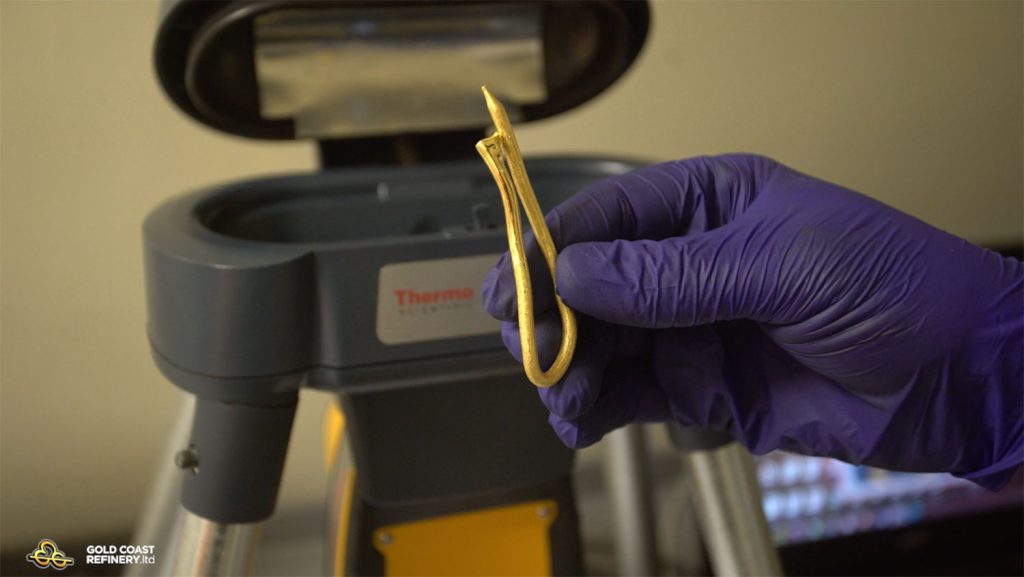
X-ray fluorescence analysis — universally known as XRF — is the most widely used professional gold testing technology in the world for non-destructive purity assessment. An XRF gold tester works by directing a beam of X-rays at the surface of the gold being tested.
The X-rays excite the atoms in the material, causing them to emit fluorescent X-rays at wavelengths characteristic of their specific elemental identity.
A detector analyses the emitted spectrum and calculates the elemental composition of the material — expressing the result as percentage concentrations of gold, silver, copper, zinc, and any other elements present.
The accuracy of XRF gold testing for surface composition is very high — typically accurate to within 0.05 to 0.1 percent for gold content in standard alloys — and modern portable XRF analysers used in professional gold dealing and refinery intake operations can produce a full elemental composition result in fifteen to thirty seconds without removing a sample or damaging the piece being tested.
XRF gold testing in African markets has become increasingly common as the cost of portable XRF devices has fallen and their availability through rental and professional service providers has increased.
A benchtop XRF spectrometer at a gold dealer’s premises provides intake quality assurance for every piece of gold received, allowing rapid identification of non-standard alloys, suspected adulteration, or declared fineness that does not match the tested composition.
The critical limitation of XRF analysis is that it measures surface composition only — typically to a depth of approximately 20 to 50 microns.
This makes it an excellent detector of base metal coins and bars, and highly accurate for cast doré and naturally occurring gold alloys, but insufficient on its own to detect tungsten-core gold bar fraud — where a gold-clad tungsten core has the correct gold surface composition but a fundamentally different interior.
For this reason, professional gold purity assessment in any context involving fabricated bars uses XRF analysis in combination with density testing and, where warranted, ultrasound or fire assay.
Density Testing: Detecting Tungsten and High-Density Adulterants
Gold density testing exploits the fact that pure gold has a highly specific density — 19.30 grams per cubic centimetre — that differs measurably from every common adulterant except tungsten.
The Archimedes principle density test for gold involves weighing the gold first in air and then while fully submerged in water, using the difference between the two weights to calculate the material’s density with high precision.
For a gold bar or coin whose measured density deviates significantly from 19.30 g/cm³, the implication is clear: the material contains something other than gold in significant proportion.
Copper-adulterated gold will measure at a lower density. Lead-adulterated gold may measure at a higher density. Gold-plated base metal pieces will typically measure at densities well below the gold standard.
Density testing as a gold purity check is inexpensive, fast, and equipment-accessible — a precision scale, a water bath, and a piece of wire to suspend the gold are all the equipment required, making it one of the most practically deployable gold testing methods for buyers in Africa who are operating in locations without access to laboratory-grade instruments.
For standard cast doré pieces, gold nuggets, and granular gold from artisanal sources, density testing provides a rapid and reliable first-pass quality indicator.
The Achilles heel of density testing is tungsten. A tungsten-core gold bar has a composite density very close to pure gold’s 19.30 g/cm³ — close enough that a standard Archimedes test may not produce a statistically significant deviation, particularly for bars where the tungsten core is a minority component.
This is why density testing, while valuable, is not sufficient on its own for the authentication of fabricated gold bars, and must be combined with other methods.
Ultrasound Testing: The Premier Method for Detecting Tungsten-Core Fraud
Ultrasound testing for gold bars is the most effective method available for detecting the internal structural anomalies — specifically tungsten cores — that density testing and XRF analysis can miss.
An ultrasound gold tester works by sending a high-frequency sound pulse into the gold bar and measuring the time it takes for the pulse to return after reflecting off the bar’s internal boundaries and opposite face.
Because tungsten and gold have different acoustic velocities — sound travels at a different speed through tungsten than through gold — a bar with a tungsten core produces a characteristic anomalous signal pattern that a trained operator or automated analysis algorithm can immediately identify.
Ultrasound gold bar authentication can detect tungsten inclusions, hollow voids, and internal composition discontinuities that are invisible to every surface-measurement technique.
Ultrasound testing services for gold bars in Africa are available through select specialised assay laboratories, major refineries, and a growing number of professional bullion dealers who have invested in this equipment as part of their intake quality assurance infrastructure.
For buyers purchasing gold bars above the 100-gram threshold — and absolutely for kilogram bar purchases and above — ultrasound testing is a strongly recommended component of the authentication process.
The Touchstone Test: Traditional Field Method for Rapid Karat Estimation
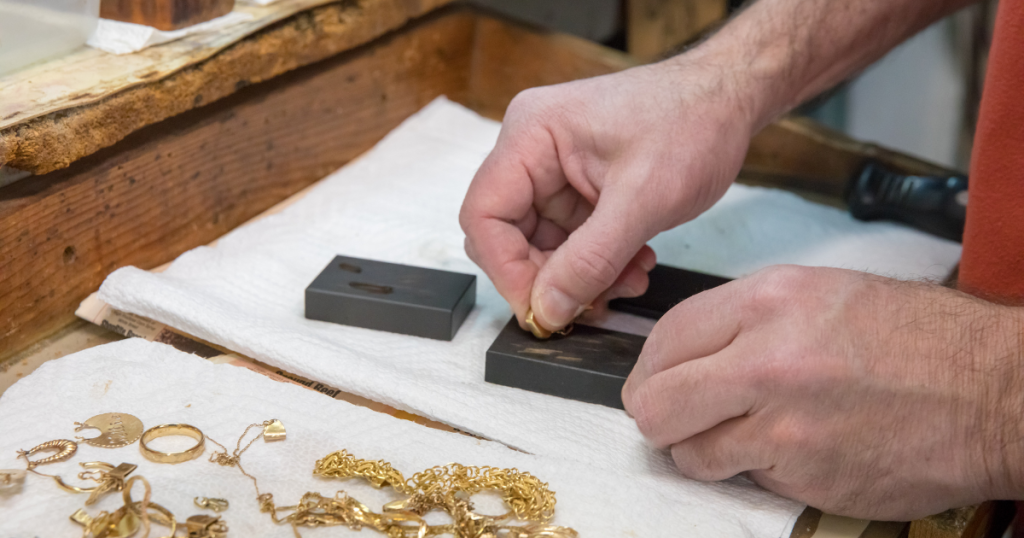
The touchstone test is among the oldest gold purity assessment methods in continuous use, predating modern chemistry by millennia. A gold touchstone is a fine-grained, dark basalt or lydite stone against which a piece of gold is rubbed to leave a streak of the metal.
The colour of the streak is compared against streaks left by reference alloys of known karat — typically a set of gold testing needles ranging from 10-karat to 24-karat — and the karat of the unknown gold is estimated by colour match.
Acid solutions — typically nitric acid in concentrations calibrated to dissolve specific gold alloys — are then applied to the streak to confirm the estimate, since higher-karat gold resists acid dissolution while lower-karat alloys are progressively dissolved.
The touchstone test remains widely used in artisanal gold markets in Africa because it requires no electricity, no laboratory facilities, and minimal equipment investment.
An experienced gold buyer using a touchstone and acid set can produce a rapid karat estimate that is accurate to within one or two karats — sufficient for the rough quality grading that characterises many informal gold transactions.
The limitations of the touchstone acid test are significant for formal commercial purposes: the method provides an estimate rather than a precise fineness measurement, it is dependent on operator skill and experience, it only tests surface material, and its results carry no documentary weight in professional gold market transactions.
It is a useful screening tool for experienced practitioners in field conditions, not a substitute for laboratory assay in any transaction involving material financial value.
Electronic Gold Testers: Accessible Technology with Important Limitations
Electronic gold testers — devices that pass a small electrical current through a gel applied to the surface of the gold and measure the resulting conductivity — are widely available in African gold markets at relatively low cost.
They provide a rapid, non-destructive karat estimate for gold jewellery and simple cast pieces, and they are extensively used by small-scale gold buyers, jewellers, and informal dealers across West, East, and Central Africa.
The accuracy of electronic gold testers is sufficient for rough sorting and initial screening — distinguishing 24-karat from 18-karat from 14-karat gold, and identifying obvious non-gold pieces — but is not reliable enough for the fineness determination required in formal bullion transactions.
Electronic testers are also susceptible to surface contamination, can produce misleading results on alloyed or treated gold, and cannot detect internal composition anomalies. They represent a useful first-pass tool and should be understood as such.
ICP-MS Analysis: The Scientific Apex of Gold Composition Testing
Inductively Coupled Plasma Mass Spectrometry — ICP-MS — represents the most analytically precise method available for gold elemental composition analysis.
An ICP-MS instrument dissolves the gold sample in acid solution, nebulises it into a plasma torch at temperatures exceeding 6,000 Kelvin, and measures the mass-to-charge ratios of the resulting ions with extraordinary precision — producing elemental concentration measurements accurate to parts per billion.
ICP-MS gold analysis is used primarily by major refineries, government laboratories, and academic institutions where the highest possible analytical precision is required — for example, in the verification of ultra-high-purity five-nines (99.999%) gold for electronics and semiconductor applications, or in forensic analysis of disputed gold provenance.
For standard commercial gold purity certification in Africa, ICP-MS is rarely the first-choice method due to its cost, the specialist expertise required for operation, and the laboratory infrastructure it demands — but it is available through several universities, government geological surveys, and private analytical laboratories in South Africa, Kenya, and Ghana that serve the professional mining and refining sector.
How to Read a Gold Assay Certificate: A Practical Guide for Buyers
A gold assay certificate is the primary documentary evidence of a gold bar’s or gold consignment’s tested purity, and understanding every element of that document is essential for any professional buyer in the African gold market.
The standard elements of a gold assay certificate include the name and accreditation details of the issuing laboratory or assay office, a unique certificate reference number, the date of assay, a description of the material submitted for testing — including the number of pieces, the declared weight, and the declared fineness — the method of assay used, the tested weight in troy ounces or grams, the tested fineness in millesimal notation, the content of gold expressed in troy ounces or grams of fine gold, and the signature or authorised stamp of the assaying officer.
For LBMA Good Delivery bar assay certificates, additional elements include the bar’s serial number, the refinery’s hallmark details, and a statement that the bar meets the dimensional, weight tolerance, and surface quality standards of the LBMA Good Delivery specification.
This combination of information links the certificate irreversibly to the specific physical bar it describes, making the certificate and the bar a matched pair whose separation should immediately raise questions for any subsequent buyer.
When reviewing a gold assay certificate from an African assay office, buyers should verify the laboratory’s accreditation status — specifically whether it holds ISO/IEC 17025 accreditation, the international standard for testing and calibration laboratory competence.
An ISO 17025 accredited gold assay laboratory in Africa operates to the same quality management standards as a recognised European or North American assay laboratory, and its certificates carry equivalent documentary weight in professional gold market transactions.
Certificates from laboratories without ISO 17025 accreditation — or from assay offices whose accreditation status cannot be independently verified — require additional scrutiny and cannot be relied upon with the same confidence.
Gold Hallmarking in Africa: Country by Country
Gold hallmarking — the official marking of gold articles with stamps attesting to their tested purity — is governed by national legislation across African countries and administered by government assay offices, national standards bureaus, or licensed hallmarking bodies.
The development and enforcement of hallmarking systems across the continent is uneven, reflecting the very different histories and priorities of individual countries’ precious metals regulatory frameworks.
Gold hallmarking in South Africa is administered through the South African Bureau of Standards (SABS) framework, with the Rand Refinery — the world’s largest integrated single-site gold refinery and one of the oldest LBMA Good Delivery accredited refineries in Africa — providing the continent’s most sophisticated gold refining and hallmarking infrastructure.
South African hallmarked gold carries international recognition commensurate with the Rand Refinery’s global standing.
Gold assay offices in Ghana operate under the framework of the Precious Minerals Marketing Company (PMMC), which provides assay and export certification services for gold produced by both large-scale mines and artisanal miners.
Ghana’s PMMC gold assay certificate is the standard documentation for gold exported through official Ghanaian channels and is recognised by international refineries receiving Ghanaian doré.
Gold purity testing in Tanzania is regulated through the Mining Commission and the Tanzania Bureau of Standards, with assay services provided at the government’s assay laboratory in Dar es Salaam and through private laboratories serving the country’s significant artisanal and small-scale mining sector.
Tanzanian gold export certification requires assay documentation from an approved laboratory as a condition of export permit issuance.
Gold assay services in Kenya operate through the Kenya Bureau of Standards and a small number of private assay laboratories in Nairobi that serve both the domestic market and the regional gold trade corridor that flows through Kenya as a transit point.
Kenya’s formal gold assay infrastructure has developed significantly in recent years in response to growing regional gold trade volumes and increased regulatory attention to gold export documentation.
Gold hallmarking and assay in Uganda falls under the Uganda National Bureau of Standards (UNBS) framework, with assay services also provided by the Bank of Uganda and selected private laboratories.
Uganda occupies a strategically important position in the regional gold trade as a transit country for gold from the Democratic Republic of Congo and as an emerging producer in its own right, making robust gold purity testing infrastructure in Uganda increasingly important for both domestic and regional market participants.
Gold assay regulation in DRC is administered through the mining regulatory framework operated by the Direction des Mines, though the fragmented geography and complex political economy of DRC’s artisanal gold sector create significant challenges for systematic purity testing and documentation.
Gold leaving DRC through formal channels must be accompanied by export documentation that includes assay certification, though the rigour with which this requirement is enforced varies significantly by region and export point.
The LBMA Good Delivery Standard: Why It Matters for African Gold
The LBMA Good Delivery specification defines the minimum standards that gold bars must meet to be accepted into the London Bullion Market clearing system — effectively the entry qualification for gold to trade at the highest level of the global market. Understanding the Good Delivery standard matters for African market participants at every level of the supply chain.
LBMA Good Delivery gold bars must weigh between 350 and 430 troy ounces (approximately 10.9 to 13.4 kilograms), must have a minimum fineness of 995 parts per thousand (99.5% pure), must carry the stamp of an LBMA-accredited refinery including the refinery’s serial number, fineness, and year of manufacture, and must meet specific surface quality standards that prohibit excessive porosity, shrinkage, cold shuts, or laminations that could affect weighing accuracy or handling safety.
The LBMA Good Delivery List for gold refineries currently includes refineries in South Africa, the United Arab Emirates, the United States, Switzerland, Canada, Australia, China, and several other countries.
In Africa, the primary LBMA-accredited refineries are concentrated in South Africa — with the Rand Refinery being the continent’s most significant Good Delivery producer — and in the UAE-connected refining operations that process significant volumes of African doré.
For African gold producers seeking LBMA market access — whether large-scale mines selling directly to the London market or regional refineries seeking to upgrade their production to institutional trading grade — achieving Good Delivery accreditation requires an extensive assessment process covering refinery infrastructure, quality management systems, assay accuracy, financial standing, and compliance with LBMA’s responsible sourcing guidelines.
The process is demanding, but the market access and pricing premium that Good Delivery accreditation unlocks make it the defining commercial goal for serious African gold refining operations.
Responsible Gold Sourcing and Conflict Gold: The Assay Connection
One of the most important dimensions of gold assay and certification in Africa is its role in the responsible sourcing framework that governs how gold moves from mine to market in conflict-affected and high-risk areas.
The connection between artisanal gold mining in eastern DRC, South Sudan, Central African Republic, and parts of Sudan and the financing of armed groups has been extensively documented by the United Nations, investigative journalists, and international NGOs — creating a commercial and reputational imperative for all participants in the African gold supply chain to verify not just the purity of the gold they handle but its provenance.
Conflict-free gold certification in Africa is implemented through several frameworks, including the OECD Due Diligence Guidance for Responsible Mineral Supply Chains, the LBMA Responsible Gold Guidance, and the Regional Certification Mechanism of the International Conference on the Great Lakes Region (ICGLR).
Each framework requires participating miners, traders, refineries, and dealers to document the chain of custody of gold from point of extraction through to refining and export — using assay data as one component of the provenance verification package.
Gold assay in conflict mineral compliance serves a specific function: by providing a chemical fingerprint of the gold’s elemental composition — including trace elements whose distribution reflects geological origin — it supports provenance verification alongside documentary chain-of-custody evidence.
While no assay method currently provides definitive geological origin identification for all gold — the research for reliable geochemical fingerprinting of gold provenance is ongoing — assay data combined with careful documentation is the current industry standard for conflict gold risk management.
Building Your Gold Testing Framework: Practical Recommendations for African Market Participants
Artisanal gold miners and cooperatives should invest in access to licensed assay services at the earliest stage of the gold selling process. Submitting gold for independent assay before sale — rather than relying on the buyer’s testing — gives the seller independent knowledge of their material’s true value and protection against systematic under-declaration of fineness by buyers with conflicting commercial incentives.
In countries where government assay offices provide free or subsidised testing for small-scale miners, this service should be utilised as a matter of routine practice.
Gold traders and licensed buying agents operating in African markets should maintain at minimum a portable XRF analyser and a precision density testing setup at every buying point.
These two instruments in combination provide rapid, non-destructive testing that catches the most common forms of gold adulteration and fineness misrepresentation.
For traders handling fabricated bar material, ultrasound capability should be added. Fire assay relationships with a licensed laboratory provide the definitive testing backstop for disputed results or high-value consignments.
Refineries processing African doré should operate full intake assay procedures that include fire assay of representative samples from every lot received, with XRF used for rapid initial sorting and fire assay used for final settlement calculations.
The difference between paying a supplier based on declared fineness and paying based on independently tested fineness can represent very significant sums on large doré lots — and the commercial case for rigorous intake assay is simply an investment in accurate pricing.
Institutional gold buyers and corporate treasury clients purchasing gold bars in African markets should require fire assay certificates and LBMA-accredited refinery documentation for every bar, conduct XRF and ultrasound testing on physical delivery, and maintain relationships with ISO 17025 accredited assay laboratories for independent verification of disputed results. The cost of testing is trivial relative to the value of the gold being protected.
The Future of Gold Assay in Africa: Technology, Infrastructure, and Opportunity
Gold assay infrastructure in Africa is developing rapidly, driven by the growing formalisation of artisanal mining, increasing regulatory attention to gold export documentation, the expansion of refinery capacity across the continent, and the rising appetite for physical gold investment among African high-net-worth individuals and institutional investors.
Mobile assay laboratories for African gold markets — containerised testing units equipped with XRF, density testing, and fire assay capability — are being deployed in several African countries to extend professional testing access to mining communities and trading hubs that lack permanent laboratory infrastructure.
These mobile units represent one of the most practically significant developments in African gold market formalisation, because they bring the testing capability to where the gold is rather than requiring the gold to travel to where the testing is.
Blockchain-based gold provenance tracking in Africa is emerging as a complementary layer to traditional assay documentation — using distributed ledger technology to record assay results, chain-of-custody transfers, and responsible sourcing compliance data in a tamper-evident digital format accessible to all parties in the supply chain.
Several pilot programmes are underway in West and East Africa, exploring how blockchain records linked to physical gold — through RFID chips, QR codes, or physical digital markers embedded in bar packaging — can enhance the transparency and fraud-resistance of the gold supply chain without replacing the fundamental accuracy of chemical assay.
Laser ablation ICP-MS for gold provenance determination — a technique that analyses the trace element and isotope ratios of gold to produce a geochemical fingerprint that can be compared against a reference database of known gold deposits — is advancing toward practical applicability for large-scale African gold markets.
When sufficiently comprehensive geological reference databases exist for African gold-producing regions, this technique could allow the geographical origin of gold to be determined directly from its chemistry, providing the most powerful conflict-mineral compliance tool yet developed. Several research institutions and major refineries are actively building these databases.
What Every Gold Buyer in Africa Must Remember About Assay and Purity Testing
Gold assay and purity testing in Africa is not a bureaucratic formality or a premium service for large-scale institutional players only. It is the fundamental act of knowing what you are buying — and in a market where the gap between stated and actual gold purity can mean the difference between a sound investment and a total loss, that knowledge is worth every cost, every delay, and every complication that obtaining it requires.
The gold in Africa is real. It is vast. It is among the finest ore bodies on earth, and the gold produced from African mines, properly refined and certified, is indistinguishable from gold from any other source. The challenge is not the gold.
The challenge is the system through which it moves — a system that, in many parts of the continent, still lacks the accredited testing infrastructure, the regulatory enforcement, and the documentation culture that professional gold markets require.
Every buyer who insists on proper assay, every seller who submits gold for independent testing before sale, every dealer who invests in professional testing equipment, and every refinery that maintains rigorous intake assay procedures is contributing to the maturation of that system — and to the building of an African gold market whose standards are worthy of the extraordinary mineral wealth beneath the continent’s feet.
Test everything. Document everything. Trust the chemistry.